Category: Behaviour change

  • The Uncertainty Meter

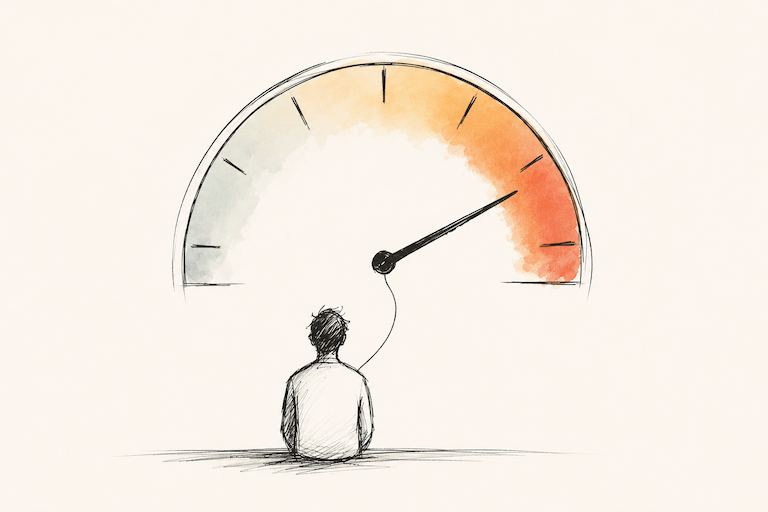
    The Uncertainty Meter

    I came across one of the most interesting ideas recently from Sarah Bergenfield speaking about the neuroscience of uncertainty.

    It’s not a new idea she is putting forward, but no less important for that.

    And why should we care about monitoring uncertainty?

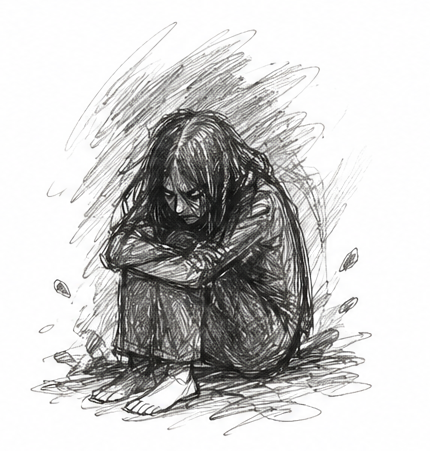
    Because “I don’t know what to do” is one of the most uncomfortable places a human being can find themselves.

    At some level, I think most of us are trying to avoid that experience.

    We want to feel like we are managing uncertainty. We kind of like the idea of not knowing exactly what comes next, but only if we have enough confidence in ourselves to handle whatever arrives. There is nothing worse than having it thrust upon you and feeling like you don’t have enough of what you need to deal with it.

    The “in over your head” experience.

    Share

    We are right to want some control, some degree of certainty. Otherwise life would simply be too much.

    Sarah’s description of uncertainty reminded me of something Aldous Huxley wrote many years ago in The Doors of Perception.

    (I explored Huxley’s ideas in more depth in an earlier essay, Cleansed Perspective, for those interested in going further down that rabbit hole.)

    Huxley proposed that the brain and nervous system function less like a camera and more like a filter.

    Reality is simply too vast, too complex and too full of information for us to take it all in. So the nervous system narrows our experience down to what appears most relevant for survival.

    In Huxley’s language, we are each connected to what he called “Mind at Large”—a reality far bigger than the small slice we normally perceive. But for practical purposes, that larger reality has to be funnelled through what he called the “reducing valve” of the brain and nervous system.

    The purpose of this filtering isn’t truth.

    It’s survival.

    From this perspective, the brain is constantly making predictions about what comes next. Most of the time those predictions are accurate enough that life feels manageable. We know where we are going, who we can trust, what tomorrow is likely to bring.

    But when reality stops matching the prediction, uncertainty rises.

    And from an evolutionary perspective, that makes perfect sense. Not knowing what is coming next could be dangerous. Better to predict, prepare and stay one step ahead.

    The challenge is that the same uncertainty that signals danger can also signal growth.

    The nervous system often struggles to distinguish between the two.

    That being said, not knowing can also be one of the highest expressions of our creativity.

    It is in not knowing that we make space for whatever new thing life is trying to birth through us.

    A relationship.

    A business.

    A book.

    A difficult conversation.

    A new version of ourselves.

    From a mythological point of view, whatever is waiting to come into being arrives through those willing to remain an empty vessel for a while.

    None of these emerge from certainty.

    They emerge from a willingness to stand in territory that cannot yet be fully mapped.

    The same uncertainty that our nervous system experiences as danger can, at times, be the very doorway through which life is trying to move us forward.

    Uncertainty is not one thing or another.

    We want to find whatever certainty we can and rest in that while simultaneously making space for the bigger reality that life itself is a profoundly uncertain place.

    What’s even more interesting to me is that uncertainty affects us differently.

    Not only do different people respond differently to uncertainty, but our own inner world can become full of contradictions around it.

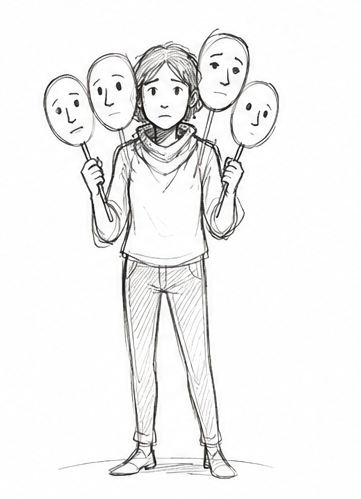
    One part may become excited.

    Another becomes terrified.

    One part freezes.

    Another immediately starts making plans.

    One part wants guarantees.

    Another wants adventure.

    Whatever the constellation of our inner experience, it seems unlikely that anything moves us quite as much as uncertainty.

    Much of psychology focuses on external triggers.

    That person upset me.

    That event stressed me.

    That conversation made me anxious.

    And of course that happens.

    But what if our state shifts are not always driven by other people?

    What if sometimes our uncertainty meter is simply running higher than usual?

    Without anything dramatic happening, we may find ourselves more tense, more contracted, more vigilant. A little more on edge than normal.

    And this inevitably shapes the lens through which we experience our day.

    Imagine you are in a fight with your partner.

    They storm out and leave.

    Your system is now not only responding to the conflict itself but also to the uncertainty surrounding it.

    When will they come back?

    Will they come back?

    What does this mean?

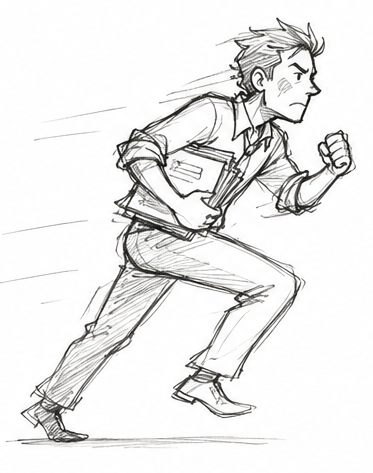
    The mind starts trying to close the gap.

    To resolve the uncertainty.

    To regain a sense of control.

    What’s fascinating is how much of this happens automatically.

    The question for me is not how do we eliminate uncertainty.

    The question is how do we grow our capacity to be with it without becoming reckless.

    This is where parts work becomes useful.

    Because uncertainty doesn’t land on neutral ground.

    We all have histories.

    Some of us grew up in homes where the world felt dangerous and unpredictable.

    Others grew up around chaos, where uncertainty was simply normal.

    Some of us learned to control.

    Some learned to avoid.

    Some learned to perform.

    Some learned to disappear.

    All of this influences how we respond when uncertainty appears.

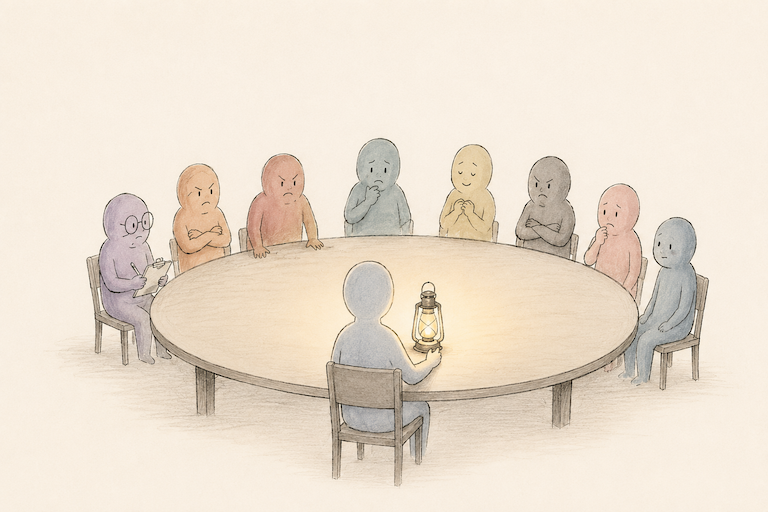
    If I listen carefully enough to the voices inside me, I often hear a range of different perspectives.

    One urges caution.

    Another sees possibility.

    Another remembers what happened last time.

    Another wants to leap.

    Perhaps the task isn’t to silence uncertainty.

    Perhaps it is to listen carefully enough to hear who is speaking.

    The beautiful thing is that we are not limited to any one of these voices.

    There is something larger that can listen to them all.

    Huxley called it Mind at Large.

    Other traditions speak of awareness, presence, Self or soul.

    Whatever language we use, most of us have touched it at some point.

    The place in us that can remain open when the rest of the system contracts.

    The place that doesn’t need certainty in order to be present.

    The more I think about it, the more useful the uncertainty meter becomes.

    Not because it tells us what to do.

    But because it helps us understand what is happening.

    One of the first questions we can ask is:

    What is influencing my meter right now?

    The most immediate zone is the self.

    Our own body.

    Our own thoughts.

    Our own internal world.

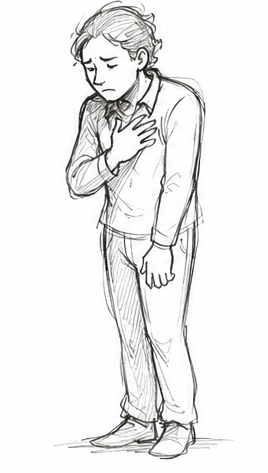
    A strange pain appears in the body.

    A symptom we don’t understand.

    A sensation we weren’t expecting.

    Suddenly uncertainty enters.

    The mind begins trying to make sense of it.

    What does this mean?

    Is something wrong?

    Do I need to worry?

    The uncertainty meter starts climbing.

    From there we move outward.

    Into our immediate environment.

    The people we live with.

    The places we spend our time.

    I know someone whose uncertainty meter was constantly activated by a building project next door.

    The noise wasn’t the problem.

    The uncertainty was.

    How long will this continue?

    What will happen next?

    When will it stop?

    The nervous system struggles when there is no predictable end point.

    Then we move outward again.

    Family.

    Relationships.

    Community.

    Perhaps it is a change at work.

    A new teacher at your child’s school.

    A shift in a friendship.

    A parent becoming ill.

    Every circle we belong to has the potential to increase or decrease our sense of certainty.

    And then we arrive at the widest circle of all.

    The world itself.

    Wars.

    Politics.

    Economic instability.

    Social change.

    To whatever extent we allow the world in, it too influences the meter.

    What strikes me is that we all have different sensitivities.

    The same event may barely register for one person and completely destabilise another.

    A war on the other side of the world.

    A change at work.

    A strange sensation in the body.

    A child struggling at school.

    The uncertainty is not only in the event.

    It is in the relationship between the event and the nervous system experiencing it.

    There is no universal uncertainty meter.

    Only our uncertainty meter.

    And perhaps that is where regulation begins.

    Not with fixing.

    Not with certainty.

    But with noticing.

    My uncertainty meter is high today.

    Something in my system is responding.

    Something in me is looking for safety.

    Just naming it can create a little more space.

    A little more compassion.

    A little less identification with the stories uncertainty generates.

    Perhaps the goal isn’t to eliminate uncertainty.

    Perhaps the goal is simply to become more aware of our relationship with it.

    To know when the meter is rising.

    To understand what is influencing it.

    And to remember that there is something in us larger than the uncertainty itself.

    To know when the meter is rising is already the beginning of wisdom.


    If you’re interested in exploring these themes further, I write regularly on Substack about uncertainty, parts work, identity, belonging, recovery, and the many ways we learn to navigate being human.

    Nineways Substack


    I’ll also be facilitating a small online Parts on Paper group starting on 24 June.

    We’ll be exploring many of these themes through reflective writing, conversation and a series of prompts designed to help us hear the different voices that emerge when life becomes uncertain.

    The aim is to become more intimate with the ways we have learned to survive.

    To understand the protectors, strategies and assumptions that shape our lives from behind the scenes.

    And perhaps, in the words of Suleika Jaouad, to become a little more creative with our survival.

    To discover new possibilities for responding to life beyond the patterns we inherited, learned or developed out of necessity.

    If you’re interested in joining the group, drop me an email and I’ll send you the details.
  • How I Carry My Father

    How I Carry My Father

    The things our fathers couldn’t finish become the things we must learn to stay with.

    My father used to say, “You gotta wanna.”

    He wrote it on scraps of wood and old boxes.

    Sometimes he’d sit with us while we absorbed those words, not really knowing what he meant by them at nine years old.

    That was his gospel, the belief that everything depended on will.

    He was right, in a way. But he left out the other half of the story:

    what happens when you don’t want to and life still asks you to stay?


    The Sander

    When I was a boy, he once brought home a manual sander, the kind with permanent sandpaper. But he never brought any wood.

    It sat unused for years, a monument to all the things that could have been made.

    He was always dreaming big, reaching for the next idea. The future seemed to call to him more strongly than the present. There were always possibilities on the horizon, but not always the small, patient steps needed to bring them into being.

    When I think about that sander now, what I feel is sadness.

    The potential was there. The tool was there. I was there.

    We could have built something together.

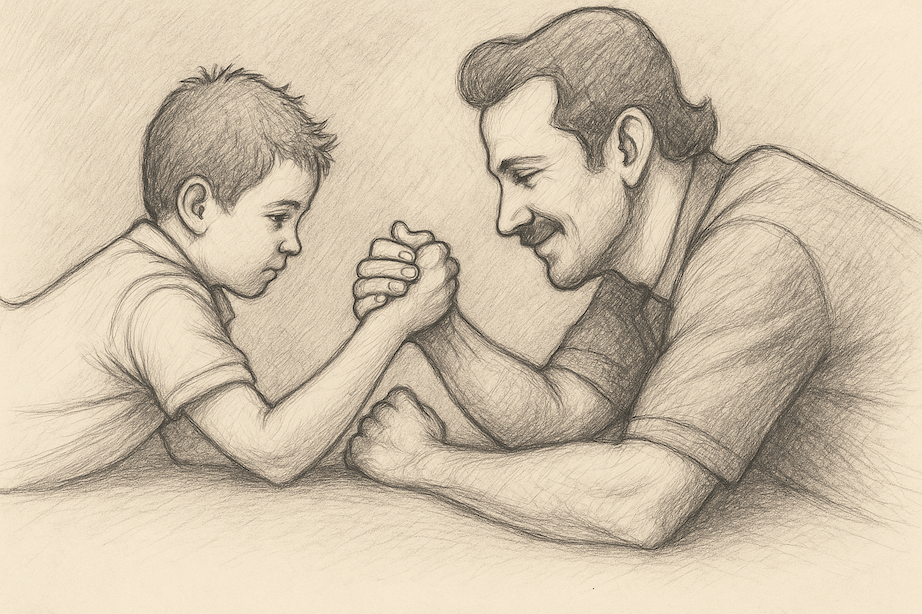
    Not because the table mattered, but because of what it would have meant. A father imagining something into existence with his son. Starting with a rough piece of wood and staying with it until it became something real.

    The older I get, the more I realise that children don’t just inherit what their parents build. They inherit what their parents believe is possible. Somehow that imagination never quite arrived between us. There were ideas, possibilities, beginnings. But not often the slow movement from start to finish.

    What I needed wasn’t the sander. I needed him beside me.


    The Shadow

    His father — my grandfather — was a maths professor in Zimbabwe. Brilliant, respected, exacting.

    That shadow must have weighed on him.

    But my father wasn’t an ordinary man standing next to an extraordinary one. In his younger years he won scholarships, engineering competitions, and was marked as someone going places. People liked him. He carried himself with a confidence that made the world seem open to him.

    And yet something happened.

    Instead of trying to measure up, he seemed to step sideways from the contest altogether.

    He had real endurance when it was on his own terms. He trained for years to earn his black belt in karate. He could push through pain, repetition and fatigue. The problem was never a lack of will.

    The problem was that his will worked best in freedom.

    When someone else set the terms — when the work wasn’t freely chosen, when conflict appeared, or when success required sustained exposure to judgment — something in him would retreat.

    I remember him helping my mother in her shop late into the night, cutting fabric by the metre. He did what needed to be done, but with a quiet resentment, as though obligation itself carried a weight he struggled to bear.

    Looking back, I don’t think effort was the issue. I think he found it difficult to stay in places where he felt measured, constrained, or exposed.

    That was the tragedy.

    Not that he lacked gifts, but that he couldn’t always bring those gifts fully into the world.


    The Battle of Will

    His will was both a gift and a trap.

    He resisted being told what to do, even when he agreed with what was being asked. Freedom mattered deeply to him. He wanted life to be chosen, not imposed.

    For a long time, I thought his struggle was perseverance. Now I think it was something more complicated.

    He could stay the course when the path felt like his own. But when commitment required surrendering control, enduring conflict, or risking failure in full view, something in him would pull away.

    There were so many thresholds he couldn’t quite cross because of that.

    Moments that asked not for more will, but for a different kind of strength — the willingness to remain present when the outcome was uncertain, when the work was unglamorous, or when success was no longer guaranteed.

    It was a constant tension between freedom and commitment, possibility and limitation, pride and exposure.

    And maybe that was the battle of his life.


    The Inheritance

    When I was younger, I thought this was the whole inheritance.

    The avoidance.

    The pride.

    The temptation to step away before failure could find me.

    But as I got older, I began to see that I had inherited other things too.

    My father loved people. He could walk into a room and feel at home. He was affectionate in a way many men of his generation were not. He told us he loved us. He hugged us. He made warmth seem natural.

    For years I compared him to his brother, who succeeded in many of the ways my father did not. It was easy to imagine that life would have been better with a different father — one who knew how to build wealth, navigate the world and get things right.

    Then after my grandfather died, my uncle confessed how sad he was that he had never really been able to hug his father.

    And suddenly the comparison wasn’t so simple.

    My father struggled with money. He struggled with business. He struggled to bring all of his gifts fully into the world.

    But love came easily to him.

    And I carry that too.


    The Turning

    That part of me still flinches from trying, afraid of what it might expose.

    But in honour of my father, I’ve spent my life walking toward the hard things —

    learning to stay, learning to fail, and learning to begin again.

    The mountains helped me.

    I found what I needed in vision quests — four days and nights alone on the land.

    I started when I was twenty-nine and finished when I was forty-three.

    My last was thirteen days on a mountain, alone.

    Those mountains taught me something my father couldn’t fully live.

    How to stay when every part of you wants to leave.

    How to sit with hunger, thirst, fear, and the voice that says you’re not enough.

    How to meet yourself at the threshold — and not turn away.

    They didn’t just teach me to stay.

    They taught me why to stay.

    For a long time I thought I went to the mountains to escape my inheritance.

    Now I think I went there to understand it.

    The question that followed me onto those mountains wasn’t really mine alone. It belonged to my father too. How do you stay when the path becomes difficult? How do you keep your heart open when life asks more of you than you want to give?

    The mountains didn’t erase those questions.

    They taught me how to sit inside them.


    The Completion

    For a long time I measured my father against his brother.

    My uncle succeeded in many of the ways my father did not. He built wealth, security and a life that looked successful from the outside. It was easy to imagine I would have been better off with him as a father.

    And maybe, in some ways, I would have been.

    I might have lived a more comfortable life. I might have worried less about money. I might have inherited more certainty about how the world works.

    But after my grandfather died, my uncle told my father how sad he was that he couldn’t even hug him.

    That stayed with me.

    Because whatever else my father struggled with, he never struggled to love us.

    He hugged us.

    He told us he loved us.

    He made affection seem natural.

    The older I get, the less interested I am in deciding which brother was successful.

    One built a life many people would want.

    The other gave me questions I couldn’t escape.

    Questions about meaning, perseverance, worth, belonging and what makes a life count.

    For years I carried my father’s failures.

    Now I see that I also carry his gifts.

    My growth has been to grow to love and want the father that I had.


    The Blessing

    If my father had given me a sander and sat beside me, if we’d made one small table together, our story might have been different.

    There are still parts of me that wonder about that life.

    The boy in me still imagines another version of his story — one where the scholarships led somewhere, where the business succeeded, where all that promise found its way into the world. Sometimes I imagine another father too. One who knew how to build foundations, who stayed with things to the end, who could have shown me how to turn possibility into reality.

    But that wasn’t the father I was given.

    I was given a man who was warm and affectionate. A man who loved people. A man who could make a stranger feel welcome. A man who carried both confidence and self-doubt, both promise and disappointment. A man who taught me as much through what he couldn’t do as through what he could.

    For years I carried my father’s failures.

    I carried the unfinished projects, the missed opportunities, the places where he turned away from himself. I carried the fear that I might do the same.

    But as I got older, I began to see something else.

    I carry his heart too.

    I carry his warmth, his generosity, his love of people. I carry his refusal to believe that money is the measure of a life. I carry the questions he left unanswered and the longing that drove him to keep searching.

    My growth has been to grow to love and want the father that I had.

    Not the father I imagined.

    Not the father who might have been.

    The father who was.

    Sometimes I still speak to him.

    Not because I need answers anymore, but because part of me is still walking with him.

    I find myself asking for his help.

    Help me get it right, Dad.

    Help me get it right for both of us.

    For the man who couldn’t always believe in his own gifts.

    For the boy who spent years trying to understand him.

    For the men who came before us who couldn’t quite stay when life became difficult, who couldn’t always trust themselves, who couldn’t always believe their lives mattered.

    Help me carry this inheritance well.

    I love you as you were.

    And I needed so much more.

    The older I get, the more I understand that both of those things are true.

    Thankfully, that so much more is now my responsibility.

    The threshold is mine to cross.

    The sander is still waiting.

  • 🌿 The Mandorla: Meeting in the Space Between

    🌿 The Mandorla: Meeting in the Space Between

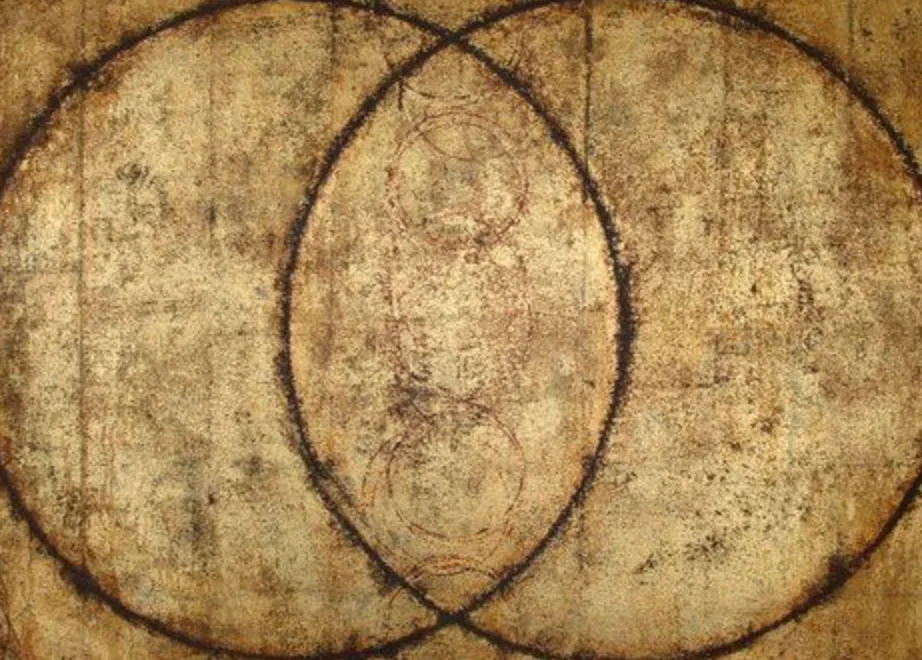
    A dear teacher of mine, Caroline Carey, shares a profound process called the Mandorla. At first glance it seems simple: two overlapping circles. Each circle represents a different truth, a polarity that exists in our lives. One may be light, the other dark. One may carry longing, the other resistance. One may be the self that feels safe in belonging, the other the self that stands apart.

    The place where the circles overlap is the Mandorla — the almond-shaped middle ground. It is not about choosing one side over the other, but about daring to stand in the space between. Here, we can get to know both sides with curiosity, without having to reject or identify with just one.

    Caroline teaches that through The Magic of Mandorla we gain profound clarity on our core wound. Rather than treating this wound as an enemy, we come to see it as an ally — a place of hidden power that, when embraced, reveals our unique gift and the contribution we are here to make.

    It is known as the most powerful of (spiritual) religious experiences we can have in life. Mandorla is the place of poetry “And the fire and the rose are one.”  T. S Eliot


    An Ancient Symbol

    The Mandorla (also known as the Vesica Piscis) is one of the most ancient sacred symbols known. Two circles overlap to form the almond-shaped space that represents divine union and the meeting of opposites: earth and sky, masculine and feminine, ego and soul, physical and spiritual. The two circles sit inside a larger one, representing total existence.

    As Caroline reminds us, this is not abstract mysticism. It is a picture of our human task: to bridge spirit and matter, to live fully grounded in our bodies while also honouring the presence of soul.


    Why the Middle Matters

    When we step consciously into each circle, we can listen: What lives here? What voice wants to be heard? Each side carries its own stories, images, and sensations. By allowing them to express themselves, we begin to see more of the truth that lives in us.

    But when we are not conscious of this movement, it is easy to get swept into extremes. We may cling to light while denying shadow, or become trapped in fear while forgetting possibility. The circles drift apart, and life feels polarised, split, or stuck.

    The Mandorla reminds us there is another way: to pause in the overlap, to hold both truths at once, and to let something larger reveal itself.


    ✍️ A Mandorla Journaling Practice

    Here’s a simple way to try the Mandorla as a creative exercise:

    1. Take a blank sheet of paper and draw two overlapping circles.
    2. Identify a polarity you feel in your life right now (e.g. freedom/security, belonging/exile, hope/fear).
    3. Step into the first circle. Write down words, images, or sensations that belong to this side. Let it speak freely.
    4. Step into the second circle and do the same — give voice to what lives there.
    5. Continue adding to each circle over days or even weeks, until both sides feel fully represented.
    6. Then move into the almond-shaped middle space — the Mandorla. Ask:
      • What is needed for balance?
      • What do these two sides want me to know?
    7. Capture what arises — whether in words, images, or symbols.

    This practice helps us hold the tension of opposites with compassion, and often reveals new possibilities that neither side could see alone.


    A Story: Thandi’s Mandorla

    Thandi is a 32-year-old woman who often finds herself caught between two powerful forces. On one side, she longs for closeness. She watches friends laughing together, feels the ache of wanting to belong, and journals often about her dream of a deep, loving partnership.

    On the other side, she fears connection. Whenever someone gets too close, she notices panic rising — a tightening in her chest, a voice whispering, “If they really knew me, they’d leave.” This fear leads her to pull away, even from people she cares about.

    Living at these extremes is exhausting. Some weeks she pushes herself into social spaces, only to feel overwhelmed and withdraw. Other times she isolates for days, missing the very connection she longs for. It feels like she’s trapped in a loop.

    When Thandi tries the Mandorla process, she draws two overlapping circles.

    • Left Circle (Longing for Connection): She writes: “Warmth, laughter, safety, being seen.” She pastes in a magazine picture of two friends embracing. She notices a soft feeling in her chest when she lets herself imagine being included.
    • Right Circle (Fearing Connection): She writes: “Danger, rejection, too much.” She sketches a shadowy figure and adds, “If they know me, I’ll lose them.” The sensation here is tightness in her stomach.

    By spending time in each circle, Thandi begins to see that both sides have something to say. The longing protects her from loneliness. The fear protects her from being hurt. Neither is “wrong.”

    Finally, she turns to the Mandorla — the almond-shaped space in the middle. She asks each side: “What is needed for balance?”

    A new voice emerges: “I want to risk small steps. I don’t need to rush. I can let people in slowly, in ways that feel safe.”

    This insight doesn’t erase the polarity — but it shows her a way forward that honours both truths. She can listen to her longing and respect her fear. She can experiment with small, safe connections, practising trust one step at a time.

    In Caroline’s words, Thandi has begun to transform her core wound — the ache of disconnection — into the gift of compassionate presence with herself and others.


    Closing Thought

    At a time when our differences — of culture, politics, faith, or identity — threaten to divide us, the Mandorla offers a different possibility. It becomes not only a personal practice, but also a collective medicine: a way of building bridges where polarity seems insurmountable.

    The polarity between opposites can be destructive, but it can also be powerfully generative. By stepping into the space between, we learn empathy, humility, and courage — qualities that ripple out into our relationships, communities, and the wider world.

    The Mandorla is not about erasing differences or forcing harmony. It is about holding tension with compassion, listening to both sides of our inner life, and allowing something new to emerge. When we meet ourselves in the space between, we may find that what once felt like conflict becomes a doorway to transformation.

  • Meditation & brushing teeth

    Meditation & brushing teeth

    I get up every day and brush my teeth, it just happens without question. I have a whole life behind me to make it one of the most natural habits.  I miss it for a variety of good reasons if I don’t do it. Same can be true for meditation. I can approach meditation like I would brushing my teeth. Not waiting for the ‘right’ days or skipping when my mood is not right.  I notice the benefits when I  show up every day a little bit at a time no matter how I am. No matter my condition is the really important piece because being willing to show up for anything builds a capacity to meet life in a more meaningful way.

    Staying connected to life feels better even when it means we feel things more intensely.  As Ken Wilber said, it bothers us less even though we feel it more.  The connection is the relief we are looking for and meditation gives us a reference early on in the day of what that experience is like.  Then we can notice how lost we can get  in all kinds of patterns and begin the most rewarding  project out there, waking up in the day we are in just as it is.

    Practice tip: I think the best way to get back in one’s  practice is start really small but do it every day. Pick a time, carve out a space in your day, preferably before  you get going, i.e. after your shower, tea or whenever you can find consistent time.  Pick a min duration that is super easy for you. Might even be 2 min. Sit, breathe, notice, allow. Rinse and repeat. Let it grow from there, if you feel to do more continue but either way when you meet your minimum threshold, have mini celebration. Feel the feeling of having completed your sit. Let that build in an organic way. It has its own way, we don’t need to do anything other than pay attention.    

  • Reimagining change

    Reimagining change

    Try as we might, we don’t change with good intentions alone.  It’s actually impossible not to change. We are changing every moment. Nothing ever stays still. The question is more how do we change in the ways that we want. I am writing this with myself in mind, what I notice about my own internal landscape.

    Part of the problem are my intentions because I am so often wrong about things so why would I assume to be right about the direction of change. In some ways its easy because outside feedback and inner intuitions find a meeting point. But perhaps in the most important ways, I simply have no idea about what I actually need and what a good direction looks like. For example, for a long time I thought corporate wasn’t the place for me to work. Turns out many years later I am happy to have corporate clients and work in an environment I once thought was unfit. In that frame I was convinced I knew what was right. What now then ? How might I be wrong about what I think I need or the direction I think my life should be going in? what does it feel like to relax the knowing? 

     It’s  often true that the part in me that wants the change is one who feels wounded or burdened in  some way. In other words the impetus to change is coming from a condition of the past.  It’s not actually a wish from an integrated self but rather an expression of unmet pain. A part that needs things a certain way in order to feel better, or a part that might be pushing away change in order to protect the hurt ones. 

    When a wounded part is not in control, the Self is free to move with the world in full acceptance of life as it is. One would not imagine needing to give advice about how to change to such a self. Without the burden, the self is open and responsive to life and the change that is happening all by itself. That self can live  in the moment and be fully available to potentials that just weren’t available to the other parts. The essential point is that all parts need to be included though, (as an ongoing practice) in order to embody the Self that can lead. The Self that can trust life.  

    The change is then more about letting go than it is trying to get something. To let go is to give space because space is what heals. It’s when we feel we have space to move that movement happens. As long as we feel stuck, it’s like nothing can breathe and if nothing can breathe we keep doing the same things, not learning from our mistakes and the mistakes of generations behind us. 

    Maybe a better way of framing change is aiming to stay as you are. Big leap maybe, staying the same is also the kind of challenge we signed up for. Born into a world where we were taught to be other than what we are.

    I think the hero’s journey is to come back to you as you and from that place, listen. So you might try this on for an idea – don’t change, rather let change happen by giving space to all of who you are.