Category: Mindset

  • When Authenticity Hurts

    When Authenticity Hurts

    The Art of Being Real (Without Losing Everyone)

    A friend of mine once tried an experiment: for three months, she decided to be 100% honest with everyone. No filters. No polite fictions. Just raw truth.
    She lost most of her relationships.

    It turns out we’re not built for complete transparency. The social fabric depends on a little pretending. Belonging, evolutionarily speaking, kept us alive

    But where’s the line? When does performance stop serving connection and start working against it?

    The Phoney Layer

    Fritz Perls, the unusual therapist who founded Gestalt therapy, used to say his task wasn’t to fix you but to bring something out of you, the way a sculptor coaxes form from stone. What is there in you that wants to come out?’ he would ask

    Sitting with Fritz wasn’t easy. He met people where they were and gave them back what they brought to him—unfiltered. He saw the psyche as a series of layers, and the first one we meet in ourselves is what he called the phoney layer.

    If you were sitting with him and he sensed you were in that layer, he would call it out immediately. “Do you know you’re doing that?” he might ask. “Do you realise you’re acting?”

    People would often get defensive. Some would break through. All of them would have to face what they were hiding.

    That was the giveaway. In the phoney layer, you’re not being real. You’re saying what you think someone wants to hear, trying to make an impression or avoid being seen a certain way. You’re managing the room instead of being in it.

    Perls saw these pretences as the first barrier to self-actualisation.

    Why We Need the Mask

    We learn to perform early. Psychologists document the “social smile” appearing within months of birth; we’re trained to manage others’ feelings before we can walk. We smile when we don’t feel like it, cry when it serves us, present a version of ourselves that will keep us safe and accepted.

    The phoney layer isn’t a personal failure. It’s a survival strategy. A cultural requirement.

    How often do we ask “How are you?” but hope the answer is “fine”? The phoney layer has become the norm. The culture rewards positivity and punishes vulnerability. Being too real, too honest, too soon can make others uncomfortable or push them away entirely.

    So what’s the cost?

    When life energy is spent on performance rather than presence, something real in us gets buried. We start to forget we can drop the act. We lose touch with what actually wants to come out.

    When Realness Backfires

    There was a woman in one of my university classes who taught me a lesson. She brought herself so fully and vulnerably—that it became hard to watch.

    She would start with “I must be honest…” and then offer something raw and unfiltered. Once, in a group discussion about family dynamics, she shared intimate details about her mothers mental illness and how it made her feel unlovable. The room went silent. You could feel people pulling back. Some subtly rolled their eyes. Her honesty was pure, but it wasn’t attuned to what the group could hold.

    Later she learned to hold back a little, to read the field, to sense what the space could carry. She still brought depth, but with discernment. Authenticity without awareness isn’t strength; it’s vulnerability without protection.

    As an Enneagram Four, I understand her impulse. Authenticity feels sacred to me. But I’ve also learned its shadow: oversharing, offering truth where it isn’t yet safe to be received. There’s a difference between being real and being reckless.

    I’ve made this mistake more times than I can count, bringing my full self to rooms that weren’t ready, thinking honesty was always the answer.

    I had a good friend who was upbeat and playful. She wanted lightness, fun, easy connection. But I kept trying to push her deeper, into more sincere relating, more vulnerability, more “realness.” I really believed this was a good impulse. But instead, my authenticity ended up pushing her away.

    What I needed to do was attune to her. To meet her where she was, not where I thought she should be.

    One of my biggest learnings over the years has been surprisingly odd: getting better at being in superficial conversations and spaces. I had so much resistance to it. Who would have thought I could develop that skill, or that it could actually be fun?

    Sometimes the deepest act of connection is allowing things to stay light.

    The Middle Path

    The writer Carlos Castaneda called this dynamic “controlled folly”—a kind of conscious play within the performance. You recognise the mask, but you wear it with awareness. You act, knowing you’re acting. It’s not naivety; it’s wisdom.

    In societies where sincerity can cost you belonging or power, controlled folly is a kind of self-protection. You choose when to reveal and when to conceal. You learn to read the field.

    This isn’t the same as the phoney layer. The phoney layer is unconscious—you’ve forgotten you’re performing. Controlled folly is conscious—you know exactly what you’re doing and why.

    Noticing the Act

    So what do we do with this phoney layer and the performing parts of us?

    We don’t shame it. We thank it. It helped us belong, survive, navigate unsafe spaces. But we can also begin to see it. To recognise when we’re in performance mode.

    You can feel it in your body. There’s a tightness, a holding. Your breath gets shallow. You’re monitoring yourself, calculating responses. You’re not quite there.

    The question isn’t “Am I being authentic enough?” but “Do I know when I’m performing?”

    That awareness changes everything. Once you can see the mask, you can choose when to wear it and when to let it slip.

    The Practice

    Think of it as a spectrum.

    On one end: fake, inauthentic, insincere. On the other: real, authentic, true.

    Where do you find yourself most of the time?

    Here’s what one notch closer to real might look like:

    • When someone asks “How are you?” saying “I’m tired” instead of automatic “fine”
    • Admitting “I need to think about that” instead of immediate agreement
    • Sharing your actual opinion instead of mirroring theirs
    • Saying “I’m not comfortable with this” when something feels off

    Small moves. Nothing dramatic. Just slightly more true.

    The invitation isn’t to strip away all masks; it’s to know when they’re on and to choose when to take them off. To move one notch closer to the real without losing the grace that keeps you connected.

    Maybe that’s what Perls was getting at: not a demand for raw honesty at all costs, but an invitation to notice the act and ask—

    What’s underneath that wants to come out?

    Maybe the real work of authenticity isn’t tearing masks off, but learning which ones still let us breathe.

  • 🌿 Morning Pages: A Practice in Clearing

    🌿 Morning Pages: A Practice in Clearing

    Writing as a way of listening — a gentle daily practice for clearing the noise and meeting yourself on the page.


    The Mind Is Noisy

    The mind is noisy. Morning Pages are a way to clear that noise — three pages, first thing, before the day begins.


    What Are Morning Pages?

    Morning Pages, developed by Julia Cameron in The Artist’s Way, are a daily writing exercise designed to unblock creativity and foster self-awareness.
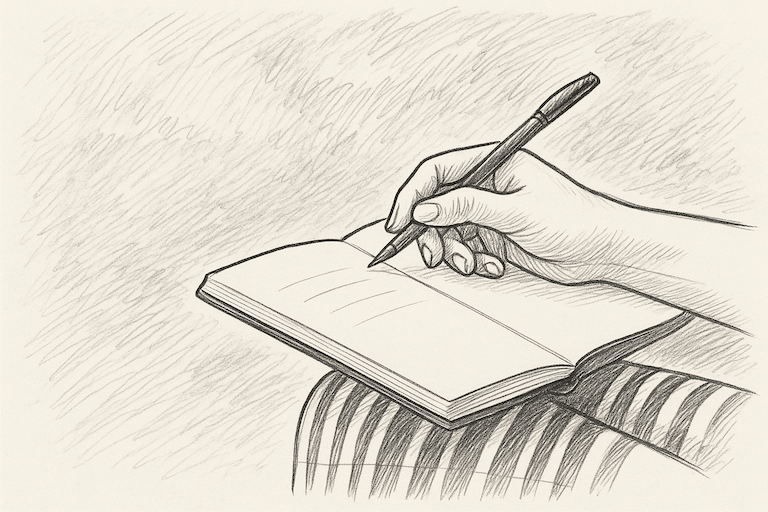
    They’re a stream of consciousness on paper — three longhand pages written before the day starts.

    You write whatever comes to mind, without censoring or editing.
    Even if it’s “I don’t know what to write; this feels pointless,” — that’s what you write.
    The process is as simple, and as profound, as that.


    Why Morning Pages Matter

    Each time we return to the page, something small reveals itself. Patterns emerge. Clarity deepens.
    The practice builds trust — not in having all the answers, but in your ability to meet yourself honestly.

    Morning Pages help us stay with what’s unfinished. They create space for what we’ve been carrying to shift into something more life-giving.
    There’s no end goal — only the slow work of becoming clearer about what’s true.

    And sometimes, when we can finally say something clearly enough, we find we’re no longer holding on to it quite so tightly.


    How to Do Morning Pages

    1️⃣ Write first thing in the morning.
    Before checking messages or engaging with the world, give yourself this space to meet your own mind before it becomes crowded.

    2️⃣ Write three pages by hand.
    Julia Cameron insists on longhand for a reason:

    “Velocity is the enemy. It takes longer to write by hand, and this slowness connects us to our emotional life.”
    The slower rhythm invites the deeper voice beneath the surface chatter.

    3️⃣ Don’t worry about grammar or structure.
    Let it be messy. This is about honesty, not performance.

    4️⃣ Don’t aim for art.
    Morning Pages are not “art.” They are a clearing — a space to empty what’s been stored inside so that something new can move through.

    5️⃣ Keep them private.
    They’re for your eyes only. This privacy makes honesty possible.

    6️⃣ Be consistent.
    The magic happens over time. Some days will feel alive, others dull — both matter.
    It’s the act of returning that builds trust.

    7️⃣ Use them to explore or vent.
    Write about what’s on your mind — your worries, hopes, lists, dreams. Over time, clarity deepens.

    8️⃣ Don’t overthink it.
    If you’re stuck, write about being stuck. Keep the pen moving. That’s the only rule.


    Writing as a Way of Listening

    In Parts on Paper, we call this writing as a way of listening.
    The focus isn’t perfection — it’s hearing what’s actually there beneath the noise.

    You might write something simple, like I take you as you were, Dad.
    At first, they’re just words. But when you stay with them — day after day — something shifts.
    Meaning unfolds, and what began as clutter becomes clarity.

    This is the work — not forcing clarity, but allowing it to emerge through repetition and return.
    What begins as scattered thoughts gradually becomes something you can see more clearly.
    And in that seeing, something releases.
    Clarity becomes its own reward.


    Permission to Be Honest

    Byron Katie says, “Judge your neighbour.”
    It sounds strange, but it’s a permission slip for truth-telling.

    Let yourself write the judgments you normally suppress — the person who irritates you, the friend who let you down, the family member who drives you mad.
    Brené Brown calls this the SFD (Shitty First Draft) — and that’s exactly what Morning Pages are for.

    When we write our judgments down, we can see them clearly instead of acting them out unconsciously.
    Sometimes they’re valid; sometimes they turn around and reveal something about us.
    Either way, they move from the shadows to the page — where they can breathe.


    A Note on Community

    Though Morning Pages are private, sharing the experience of the practice can be powerful.
    In our Parts on Paper groups, each person writes alone — but reflecting together on what the practice brings up reminds us we’re not alone on the journey of self-discovery.


    Final Thought

    Let yourself watch the words pour out of your pen.
    The more you do, the more you’ll see — you’re not really doing the writing.

    Writing, like breathing, just happens.
    You catch the current and let it flow.

    What a strange and beautiful thing — to witness life pouring itself through you. 🌿

  • How I Carry My Father

    How I Carry My Father

    The things our fathers couldn’t finish become the things we must learn to stay with.

    My father used to say, “You gotta wanna.”

    He wrote it on scraps of wood and old boxes.

    Sometimes he’d sit with us while we absorbed those words, not really knowing what he meant by them at nine years old.

    That was his gospel, the belief that everything depended on will.

    He was right, in a way. But he left out the other half of the story:

    what happens when you don’t want to and life still asks you to stay?


    The Sander

    When I was a boy, he once brought home a manual sander, the kind with permanent sandpaper. But he never brought any wood.

    It sat unused for years, a monument to all the things that could have been made.

    He was always dreaming big, reaching for the next idea. The future seemed to call to him more strongly than the present. There were always possibilities on the horizon, but not always the small, patient steps needed to bring them into being.

    When I think about that sander now, what I feel is sadness.

    The potential was there. The tool was there. I was there.

    We could have built something together.

    Not because the table mattered, but because of what it would have meant. A father imagining something into existence with his son. Starting with a rough piece of wood and staying with it until it became something real.

    The older I get, the more I realise that children don’t just inherit what their parents build. They inherit what their parents believe is possible. Somehow that imagination never quite arrived between us. There were ideas, possibilities, beginnings. But not often the slow movement from start to finish.

    What I needed wasn’t the sander. I needed him beside me.


    The Shadow

    His father — my grandfather — was a maths professor in Zimbabwe. Brilliant, respected, exacting.

    That shadow must have weighed on him.

    But my father wasn’t an ordinary man standing next to an extraordinary one. In his younger years he won scholarships, engineering competitions, and was marked as someone going places. People liked him. He carried himself with a confidence that made the world seem open to him.

    And yet something happened.

    Instead of trying to measure up, he seemed to step sideways from the contest altogether.

    He had real endurance when it was on his own terms. He trained for years to earn his black belt in karate. He could push through pain, repetition and fatigue. The problem was never a lack of will.

    The problem was that his will worked best in freedom.

    When someone else set the terms — when the work wasn’t freely chosen, when conflict appeared, or when success required sustained exposure to judgment — something in him would retreat.

    I remember him helping my mother in her shop late into the night, cutting fabric by the metre. He did what needed to be done, but with a quiet resentment, as though obligation itself carried a weight he struggled to bear.

    Looking back, I don’t think effort was the issue. I think he found it difficult to stay in places where he felt measured, constrained, or exposed.

    That was the tragedy.

    Not that he lacked gifts, but that he couldn’t always bring those gifts fully into the world.


    The Battle of Will

    His will was both a gift and a trap.

    He resisted being told what to do, even when he agreed with what was being asked. Freedom mattered deeply to him. He wanted life to be chosen, not imposed.

    For a long time, I thought his struggle was perseverance. Now I think it was something more complicated.

    He could stay the course when the path felt like his own. But when commitment required surrendering control, enduring conflict, or risking failure in full view, something in him would pull away.

    There were so many thresholds he couldn’t quite cross because of that.

    Moments that asked not for more will, but for a different kind of strength — the willingness to remain present when the outcome was uncertain, when the work was unglamorous, or when success was no longer guaranteed.

    It was a constant tension between freedom and commitment, possibility and limitation, pride and exposure.

    And maybe that was the battle of his life.


    The Inheritance

    When I was younger, I thought this was the whole inheritance.

    The avoidance.

    The pride.

    The temptation to step away before failure could find me.

    But as I got older, I began to see that I had inherited other things too.

    My father loved people. He could walk into a room and feel at home. He was affectionate in a way many men of his generation were not. He told us he loved us. He hugged us. He made warmth seem natural.

    For years I compared him to his brother, who succeeded in many of the ways my father did not. It was easy to imagine that life would have been better with a different father — one who knew how to build wealth, navigate the world and get things right.

    Then after my grandfather died, my uncle confessed how sad he was that he had never really been able to hug his father.

    And suddenly the comparison wasn’t so simple.

    My father struggled with money. He struggled with business. He struggled to bring all of his gifts fully into the world.

    But love came easily to him.

    And I carry that too.


    The Turning

    That part of me still flinches from trying, afraid of what it might expose.

    But in honour of my father, I’ve spent my life walking toward the hard things —

    learning to stay, learning to fail, and learning to begin again.

    The mountains helped me.

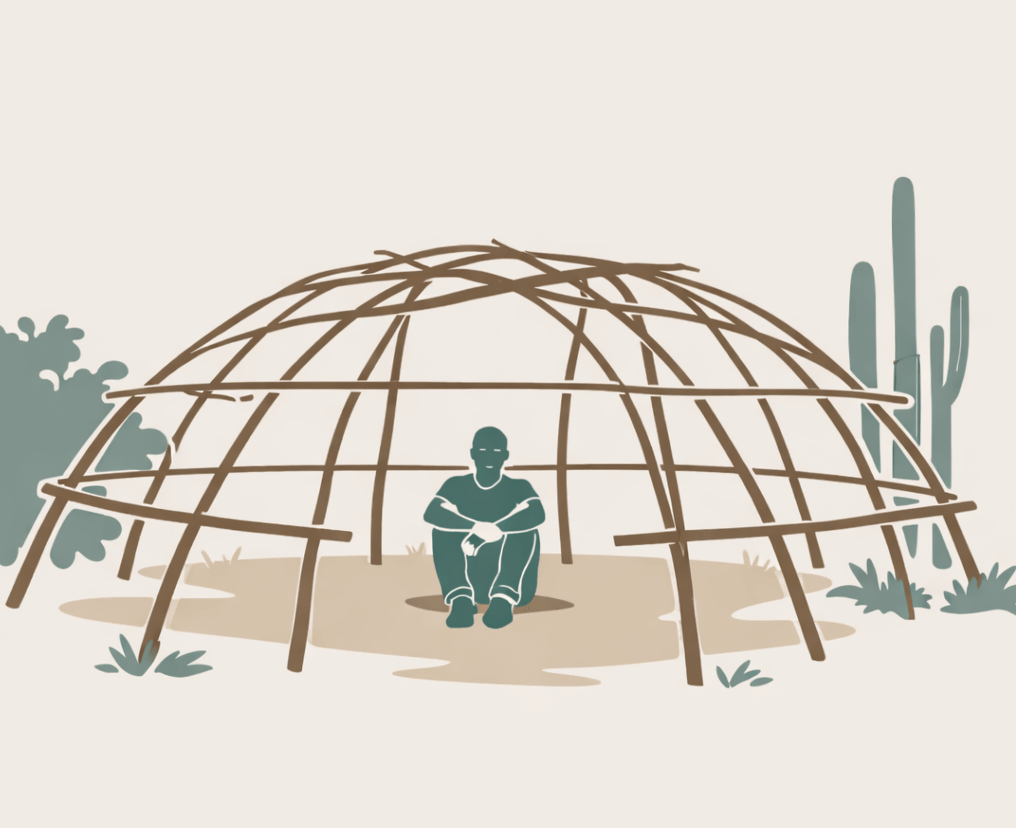
    I found what I needed in vision quests — four days and nights alone on the land.

    I started when I was twenty-nine and finished when I was forty-three.

    My last was thirteen days on a mountain, alone.

    Those mountains taught me something my father couldn’t fully live.

    How to stay when every part of you wants to leave.

    How to sit with hunger, thirst, fear, and the voice that says you’re not enough.

    How to meet yourself at the threshold — and not turn away.

    They didn’t just teach me to stay.

    They taught me why to stay.

    For a long time I thought I went to the mountains to escape my inheritance.

    Now I think I went there to understand it.

    The question that followed me onto those mountains wasn’t really mine alone. It belonged to my father too. How do you stay when the path becomes difficult? How do you keep your heart open when life asks more of you than you want to give?

    The mountains didn’t erase those questions.

    They taught me how to sit inside them.


    The Completion

    For a long time I measured my father against his brother.

    My uncle succeeded in many of the ways my father did not. He built wealth, security and a life that looked successful from the outside. It was easy to imagine I would have been better off with him as a father.

    And maybe, in some ways, I would have been.

    I might have lived a more comfortable life. I might have worried less about money. I might have inherited more certainty about how the world works.

    But after my grandfather died, my uncle told my father how sad he was that he couldn’t even hug him.

    That stayed with me.

    Because whatever else my father struggled with, he never struggled to love us.

    He hugged us.

    He told us he loved us.

    He made affection seem natural.

    The older I get, the less interested I am in deciding which brother was successful.

    One built a life many people would want.

    The other gave me questions I couldn’t escape.

    Questions about meaning, perseverance, worth, belonging and what makes a life count.

    For years I carried my father’s failures.

    Now I see that I also carry his gifts.

    My growth has been to grow to love and want the father that I had.


    The Blessing

    If my father had given me a sander and sat beside me, if we’d made one small table together, our story might have been different.

    There are still parts of me that wonder about that life.

    The boy in me still imagines another version of his story — one where the scholarships led somewhere, where the business succeeded, where all that promise found its way into the world. Sometimes I imagine another father too. One who knew how to build foundations, who stayed with things to the end, who could have shown me how to turn possibility into reality.

    But that wasn’t the father I was given.

    I was given a man who was warm and affectionate. A man who loved people. A man who could make a stranger feel welcome. A man who carried both confidence and self-doubt, both promise and disappointment. A man who taught me as much through what he couldn’t do as through what he could.

    For years I carried my father’s failures.

    I carried the unfinished projects, the missed opportunities, the places where he turned away from himself. I carried the fear that I might do the same.

    But as I got older, I began to see something else.

    I carry his heart too.

    I carry his warmth, his generosity, his love of people. I carry his refusal to believe that money is the measure of a life. I carry the questions he left unanswered and the longing that drove him to keep searching.

    My growth has been to grow to love and want the father that I had.

    Not the father I imagined.

    Not the father who might have been.

    The father who was.

    Sometimes I still speak to him.

    Not because I need answers anymore, but because part of me is still walking with him.

    I find myself asking for his help.

    Help me get it right, Dad.

    Help me get it right for both of us.

    For the man who couldn’t always believe in his own gifts.

    For the boy who spent years trying to understand him.

    For the men who came before us who couldn’t quite stay when life became difficult, who couldn’t always trust themselves, who couldn’t always believe their lives mattered.

    Help me carry this inheritance well.

    I love you as you were.

    And I needed so much more.

    The older I get, the more I understand that both of those things are true.

    Thankfully, that so much more is now my responsibility.

    The threshold is mine to cross.

    The sander is still waiting.

  • What I Learned from 21 Days of Morning Pages on Belonging

    What I Learned from 21 Days of Morning Pages on Belonging

    “The greatest thing in the world is to know how to belong to oneself.” — Montaigne

    Belonging is not just a nice-to-have. It’s a fundamental human need. Without it, we wither. At times, it can feel easier to starve than to live without a place where we are truly received.

    And yet, so many of us carry the wound of not belonging. There is hardly anyone on this planet who hasn’t, at some point, felt the sting of exclusion—being pushed out, turned away, or conditionally welcomed. You can stay, but it’s going to cost you, goes the unspoken contract.

    Witnessing the Wound

    I once participated in a training where we each took turns standing outside a circle while the rest of the group turned inward. It was only an exercise, but the feelings were achingly real. On the outside, pacing, the body remembers: I’ll do anything to be part of this. And beneath that, the grief of all the times the circle never opened—no matter what we tried.

    This is an experience so deeply human that we will do almost anything to avoid it. Sometimes we give up our principles just to stay in the circle. Perhaps this explains some of what we see in the world today.

    These experiences don’t vanish with time. They shape how we show up, what we allow ourselves to do—or not do. And because they cut so deep, the wounds of belonging are heavily protected.

    A Dream of Belonging

    On the very first night of my 21-day writing journey, I had a dream. In it, all the wounds I carried around belonging were suddenly gone.

    I knew, without question, that I belonged. That belonging could never be taken away. Wherever I went, this knowing accompanied me. It was like the innocence of a child who has never been excluded—now present in the adult who has lived and seen the world.

    The change was remarkable. Without fear, I could bring myself to anything. Life became more like a dance—fluid, responsive, impossible to be apart from. There was no loss to fear, because the movement never stops.

    What Participants Discovered

    I wasn’t alone in these discoveries. Others in the Parts on Paper: Belonging & Roots group shared profound insights:

    “I’ve been searching for belonging most of my life and realized I was unconsciously resisting it. When I discovered why, it felt like the floodgates opened. This has been a small but deeply significant pause on my journey.”

    “I realized that more often than not, people accept me. There are many places I belong. The rejection I felt was rooted in my own shame, not reality. People accept and love me just as I am.”

    “The group was transformational. Ryan’s guidance, the group insights, and daily writing allowed rigid parts of me to shift. This led directly to improved relationships and a deeper sense of acceptance.”

    An Invitation

    Belonging begins with ourselves, but it flourishes in community. Writing together opens doors that are difficult to find alone.

    The next Parts on Paper group begins in September. If this resonates with you, you’re warmly invited to join us.

    Spaces are limited. Subscribe to our list for updates.

    Your subscription could not be saved. Please try again.
    Your subscription has been successful.

    Join the Parts on Paper Community

    Sign up for Parts on Paper updates to receive news about upcoming groups, reflections, and writings.

  • The Trap You Don’t Have to Escape From

    The Trap You Don’t Have to Escape From

    I felt that same old familiar feeling — rock and a hard place, as the saying goes. I’ve been there many, many times before. That place where there really doesn’t seem to be any movement either way. You’re damned.

    If you’re quiet enough, the answer will come. The movement will come.
    And it’s not a movement that comes from your mind.
    Hell, you can’t even take credit for it — because there’s nothing you did for it, except one big thing:

    Give up the struggle.

    Instead of trying to find your way out of the hard place, forcing solutions, trying to figure it all out, or arguing with life about why you’re in there in the first place, you do something so counterintuitive, so revolutionary, that your mind nearly jumps out of its own head.

    You simply stop the struggle.

    Imagine being tied up in one of those knots that only tightens the more you pull. That’s not far from the truth of the hard place. It’s as if the more we try to wrestle our way out, the deeper we dig the hole.

    But still — no one likes being stuck. And rightly so.

    Maybe I shouldn’t speak for everyone. I’ve met a few who seem to prefer stuckness because the idea of freedom is just too overwhelming.
    But most of us, I imagine, would much rather be free.
    And there’s nothing worse than the feeling of no movement.

    What I’m getting at is this: stuckness — the not-knowing, the confusion, the fog, the feeling lost — these are all forms of the hard place.
    And I don’t think any of that is actually the problem.

    In fact, I think we’d be wise to expect them.
    Being lost and confused is just part of being human.

    I watched this series recently — Somebody Somewhere — and I highly recommend it for the realness of its characters and the vulnerability of its story. There’s a line that changes the course of the main character Sam’s life. Her friend says to her:

    “No one knows what they’re doing.”

    Never has a truer word been spoken.
    None of us really know.
    We’re just making it up as we go, and stumbling as we go.

    But somehow, we’ve picked up this bad habit of expecting more from ourselves, like we ought to know better.
    Well, how on earth ought we to know more than we do?

    It’s a total delusion. We can only know what we know.
    And we’re going to get it wrong — again and again — and that does not need to be a problem.

    In fact, in my experience, the less I make it a problem, the more I learn.

    So back to that damned ditch I was in — that old familiar feeling. Can’t say yes, can’t say no. No obvious way to go.

    But something strange happened.

    I noticed I wasn’t so afraid of the feeling anymore.
    And a little voice inside reminded me:
    I am completely free to make my best move.

    I think of a tennis court — the best rallies, the impossible shots that come out of impossible angles.
    Even if the player loses the point, we love watching that kind of play — the creativity, the comeback, the refusal to give in.

    Something in us lights up when we see someone come back from a hard place.
    People rising out of difficulty, big or small — it’s an endless fascination.

    So maybe the point isn’t to wish for the rock and the hard place.

    But what if we could be just a little more grateful for those moments?
    Because they’re asking something of us — something more than we think we have.

    And the only way out… is in.
    To trust that it’s in you, in me, in everyone — and to learn to follow it.