

In movement, we engage in a kind of alchemy of the past. We come into relation with ourselves, not as we want to be but as we actually are. This can be a very sobering coming home because we become aware of things we weren’t so connected to before.
Way back when and all the way to now, we shut off those difficult experiences because they were too much, and no one was there to guide us. We had to learn to close off, to numb out, to disconnect in any way we could. Yet, those strategies did nothing to help the parts of us that got locked out.
In movement, though, we can safely enter those places that are undigested, unresolved, and calling out for the light of awareness. I have been taught that being alone in your pain is not the same as being witnessed in it. There is something in the witnessing that allows us to release in a different way, as if we are longing to be seen in our whole being. Arguably, allowing that kind of seeing in is what heals us. We get the message from the outside that we’re okay, even in the worst of it.
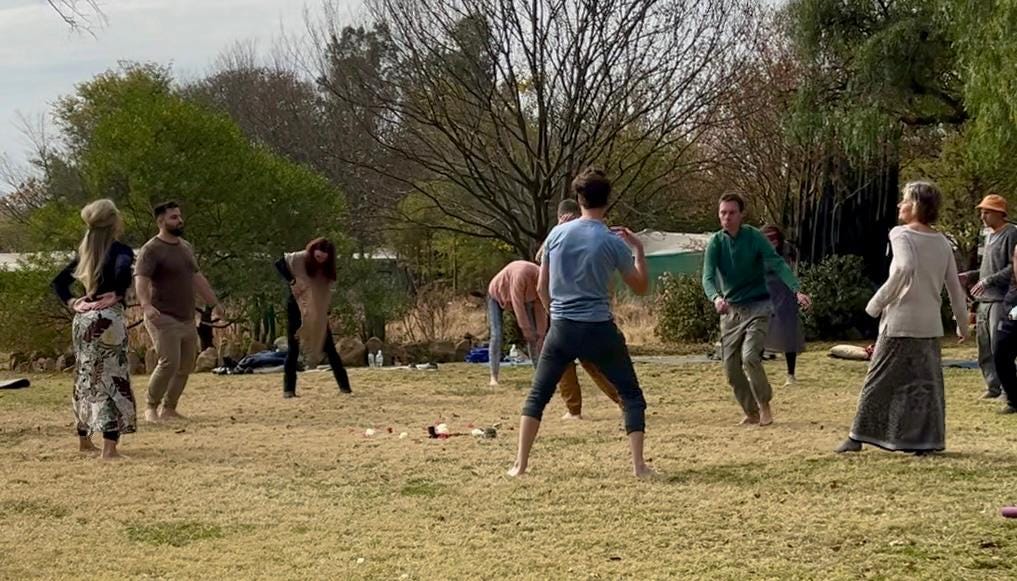
We really are okay even if we don’t feel that way. When we open to what we are a part of, there is no other option but to heal. Healing not as a deliberate act but rather a consequence of letting in that connectedness. Remembering a little at a time where we come from, what we are connected to, and what moves us. Not what we think should excite us, but what actually does. And it’s the body that tells us, that carries this truth to what author, Robert Greene calls our primal inclination—the thing that we don’t need to second guess; it just feels right.
I came to dance in my twenties, at a time in my life when I was very shut down. I had chronic fatigue that I could not shake no matter how much I tried. Nothing worked, and few doctors had anything sensible to tell me. Movement for me was probably the first medicine that actually started to work. Not that there were overnight changes, but slowly, over time, I began to get into the hard-to-reach places and thaw some of the numb, shut down, frozen parts in me. It was this quality of movement that invited me to move with how I actually was, and not how I wanted to be, that made it possible to be with myself in a kinder way. It was the discovery of this kindness that I think, more than anything else, allowed the illness to move.
How to Dance?
If it’s not something you do often, it’s easy to start. Take any music you like and match it with your mood. If you feel down, don’t go straight to the upbeat stuff. Start where you are, letting go of any expectation for it to be different. You can make as many “mistakes” as you like, only to see that the only real mistake is to stay still. Follow your body, include your whole body, and be curious. Start with just a few minutes, anywhere, anytime.
