Author: Ryan Klette

  • Doing in Balance

    Doing in Balance

    Finding rest inside action

    The easiest way to check your state is to notice your breathing.

    This week we’re exploring doing energy that’s in balance — not pushing, forcing, or over-exerting. Of course we’ll find ourselves in and out of balance all through the day. There’s no nervous system that’s perfectly steady, and that’s okay.

    One of the biggest obstacles to balanced doing in this modern world is distraction. There’s so much tugging at our attention that we often end up frazzled, scattered, unsure what to do next — or trying to do it all at once. The big delusion of our time is that we get more done through frantic, chaotic energy. But nothing could be further from the truth.

    Cal Newport writes about this in Slow Productivity, where he makes a clear case for doing more with less. If you think about how much more meaningful work you’d do if you were distracted less — that’s not pushing harder; that’s simply removing what pulls you away from what matters.

    It’s all related. I often find myself doing a lot, but with more stress in the doing than is really needed. One story I carry is feeling behind. I’ve spent much of my life feeling like I have to catch up, and that belief colours my actions. Whatever I’m doing, it can feel like it’s never enough — as if I’m working through a backlog that will never end. The task becomes less about its own value and more about clearing the list.

    There are many stories that attach themselves to doing. Another common one is I won’t get it right or it won’t be good enough. Just notice what comes up for you around action, doing, or performing. It’s all good material for your pages.

    There’s nothing wrong with the satisfaction of crossing things off, but what counts more is how I bring myself to those tasks. More often than not, slower is faster. This racing around can feel productive, but when you look closely, much of it is wasted energy disguised as busyness.

    When we strip away distractions and focus on what’s in front of us, we not only get more done but do it in a smoother, more integrated way. In that open, balanced mode, our creative and higher faculties come online. Life starts to feel less like a series of problems to fix and more like a field of movement and response.

    The Stoics had this insight — that obstacles aren’t just part of the path; they are the path. The obstacle is the way. Even small glimpses of this in your day count as progress.

    And how often do we look around for something that was in front of us all along?

    When we move through life in a more balanced way, we tend to find those things sooner — not because they suddenly appear, but because we’re less sympathetically charged. The push itself can become counterproductive. When the body is calm, the field of awareness expands. We’re no longer seeing through the narrow lens of the sympathetic nervous system. It makes all the difference to carry a little of that openness and expansiveness with us as we move through the day.

    So this week, keep writing. Keep noticing where your doing feels balanced — not holding back, not pushing forward. Notice when your writing slips into flow: what does it feel like in your body? How’s your breathing? What are the markers? How do you know when you’re more in that place?

    Try the same outside of writing. Can you notice when your doing carries tension, anxiety, or worry? What story are you telling yourself then?

    One common pattern is that when we hold back too much, it builds up pressure and catapults us into over-doing — that swing between inertia and overdrive. I know it well.

    There’s a story about the boxer Floyd Patterson, who was known to nap in the dressing room right before title fights. Reporters would watch him sleep and later hear him talk about it — his dreams, his calm, his fear. It’s an extreme example, but it beautifully illustrates the point: how deep yin can support strong yang.

    When Floyd stepped into the ring, his being came from deep rest. He could switch in a moment into full fight mode — but the difference was that he had preserved his energy. Nothing wasted in unnecessary tension. All his resources gathered, ready to give everything to the task at hand — to give his best fight.

    This week, make some space to find that still point before action — to rest inside the doing. That’s the essence of balanced yang.

    And maybe noticing, too, that sometimes what we’re afraid of isn’t failing, but actually arriving — finishing, succeeding, being seen.

    This week, let this question from Gary Keller’s The One Thing be a kind of guiding light — a way of bringing yourself more fully to the task at hand.

    “What’s the one thing I can do right now such that by doing it, everything else becomes easier or unnecessary?”

    That question can become a kind of internal compass — a way of dropping out of scattered effort and into the one movement that really matters. It might lead you to the dishes, to a work task, or to the gym — nothing is too trivial. The point isn’t what you do, but whether it’s the right action for you in this moment.

    And it’s an experiment — learn, adjust, and try again. Let it include a sense of playfulness. It doesn’t need to feel like the most serious thing in the world.

    You might also try a simple breath practice to help regulate your doing energy —
    inhaling through the nose for five seconds, exhaling through the nose for five seconds.
    Do this a few times a day, even just for a few minutes. It’s a small reset that reminds the body how to return to balance.

    I’ll end with one of my favourite ideas from Suleika Jaouad:

    “Let your survival be a creative act.”

  • 🌿 Yin Practice: Listening, slowing down to speed up

    🌿 Yin Practice: Listening, slowing down to speed up

    Society values the push — the doing, the achieving, the forward motion.
    But this week, we’re turning our attention toward being.


    Thresholds and the Parts That Resist

    As we bring awareness to thresholds, it’s normal to feel some fear or anxiety.
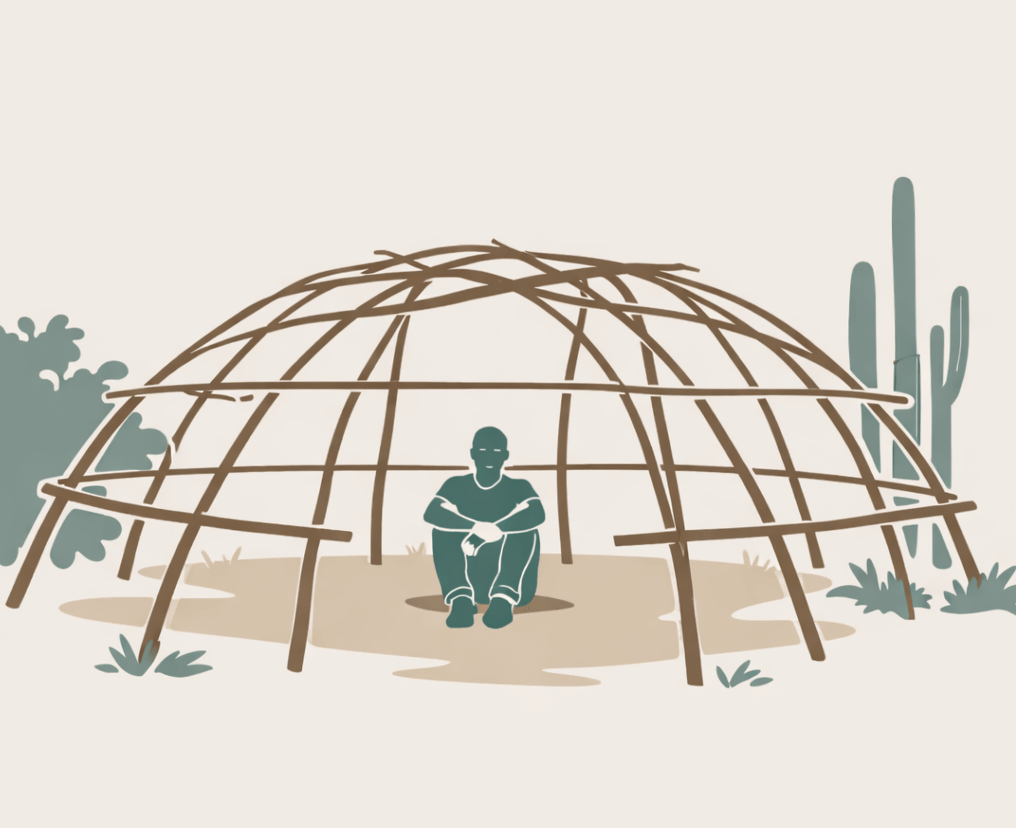
    Like Leeane shared about Monja — at the end of the sweat lodge she said she could do more than she thought. She surprised herself: “Look at that — I got through.”
    It leaves you with that quiet sense of wonder: I wonder what else I can do?

    If you think back to the thresholds you’ve already crossed, they often carry that same feeling of strength — each time something in us breaks open: an old idea, a fear, a long-held family belief.

    This week, notice your relationship to thresholds — the ones you’ve crossed and the ones still waiting.
    They show up in our everyday lives as much as in the big cycles.

    As we move through these inevitable challenges, we also meet the parts of us that say, “Hell no, I don’t want to go.”
    Get curious about the small (and maybe big) things you hold back from.

    A small example: I know I need to get myself exercising, but something in me doesn’t want to.
    If you gave that voice space, what would it say?

    Maybe: “Rest is important right now.”
    That might be valid.
    Or maybe: “I can’t let myself be seen like this — unfit, not worthy.”

    We can listen with curiosity to these stories. They often lead back to earlier experiences when not going felt like the only way to stay safe.


    A Story from My Own Pages

    I remember one of my earliest experiences of not going was to karate camp.
    I was seven, and there was an older kid who bullied me. I went, but I bunked most of the weekend, and shortly after, I quit karate altogether.

    It became a threshold I didn’t cross again — the one that taught me to avoid physical difficulty.
    Over the years, I’ve learned to help that young part of me — to put down the burden of feeling like it was his fault for not getting through.
    He really did the best he could with what he had.

    And I helped him find new thresholds to cross — but this time, we looked for mentors, people who had gone before and could show us how.
    What a difference that made to a boy who had few men taking an interest in him.
    He loved that idea. Deep down, he knew he couldn’t do it alone.


    This Week’s Invitation

    As we explore thresholds, check in with your parts:
    What do they need to cross?
    What gives them strength?
    What will help them?

    These are very different questions from what society teaches: Push harder. Be stronger.

    This week we’re inviting more being — the yin quality.
    Slowing down, even for a few minutes, and listening.

    It may look like:

    • Reaching for your phone less
    • Giving yourself a few moments each day that are non-directional
    • Letting yourself walk with less of a need to get somewhere
    • Letting play arise — not to get anywhere, just to be.

    If you find this hard, no problem.
    Just notice it — and put it in your pages.

  • 🌿 Morning Pages: A Practice in Clearing

    🌿 Morning Pages: A Practice in Clearing

    Writing as a way of listening — a gentle daily practice for clearing the noise and meeting yourself on the page.


    The Mind Is Noisy

    The mind is noisy. Morning Pages are a way to clear that noise — three pages, first thing, before the day begins.


    What Are Morning Pages?

    Morning Pages, developed by Julia Cameron in The Artist’s Way, are a daily writing exercise designed to unblock creativity and foster self-awareness.
    They’re a stream of consciousness on paper — three longhand pages written before the day starts.

    You write whatever comes to mind, without censoring or editing.
    Even if it’s “I don’t know what to write; this feels pointless,” — that’s what you write.
    The process is as simple, and as profound, as that.


    Why Morning Pages Matter

    Each time we return to the page, something small reveals itself. Patterns emerge. Clarity deepens.
    The practice builds trust — not in having all the answers, but in your ability to meet yourself honestly.

    Morning Pages help us stay with what’s unfinished. They create space for what we’ve been carrying to shift into something more life-giving.
    There’s no end goal — only the slow work of becoming clearer about what’s true.

    And sometimes, when we can finally say something clearly enough, we find we’re no longer holding on to it quite so tightly.


    How to Do Morning Pages

    1️⃣ Write first thing in the morning.
    Before checking messages or engaging with the world, give yourself this space to meet your own mind before it becomes crowded.

    2️⃣ Write three pages by hand.
    Julia Cameron insists on longhand for a reason:

    “Velocity is the enemy. It takes longer to write by hand, and this slowness connects us to our emotional life.”
    The slower rhythm invites the deeper voice beneath the surface chatter.

    3️⃣ Don’t worry about grammar or structure.
    Let it be messy. This is about honesty, not performance.

    4️⃣ Don’t aim for art.
    Morning Pages are not “art.” They are a clearing — a space to empty what’s been stored inside so that something new can move through.

    5️⃣ Keep them private.
    They’re for your eyes only. This privacy makes honesty possible.

    6️⃣ Be consistent.
    The magic happens over time. Some days will feel alive, others dull — both matter.
    It’s the act of returning that builds trust.

    7️⃣ Use them to explore or vent.
    Write about what’s on your mind — your worries, hopes, lists, dreams. Over time, clarity deepens.

    8️⃣ Don’t overthink it.
    If you’re stuck, write about being stuck. Keep the pen moving. That’s the only rule.


    Writing as a Way of Listening

    In Parts on Paper, we call this writing as a way of listening.
    The focus isn’t perfection — it’s hearing what’s actually there beneath the noise.

    You might write something simple, like I take you as you were, Dad.
    At first, they’re just words. But when you stay with them — day after day — something shifts.
    Meaning unfolds, and what began as clutter becomes clarity.

    This is the work — not forcing clarity, but allowing it to emerge through repetition and return.
    What begins as scattered thoughts gradually becomes something you can see more clearly.
    And in that seeing, something releases.
    Clarity becomes its own reward.


    Permission to Be Honest

    Byron Katie says, “Judge your neighbour.”
    It sounds strange, but it’s a permission slip for truth-telling.

    Let yourself write the judgments you normally suppress — the person who irritates you, the friend who let you down, the family member who drives you mad.
    Brené Brown calls this the SFD (Shitty First Draft) — and that’s exactly what Morning Pages are for.

    When we write our judgments down, we can see them clearly instead of acting them out unconsciously.
    Sometimes they’re valid; sometimes they turn around and reveal something about us.
    Either way, they move from the shadows to the page — where they can breathe.


    A Note on Community

    Though Morning Pages are private, sharing the experience of the practice can be powerful.
    In our Parts on Paper groups, each person writes alone — but reflecting together on what the practice brings up reminds us we’re not alone on the journey of self-discovery.


    Final Thought

    Let yourself watch the words pour out of your pen.
    The more you do, the more you’ll see — you’re not really doing the writing.

    Writing, like breathing, just happens.
    You catch the current and let it flow.

    What a strange and beautiful thing — to witness life pouring itself through you. 🌿

  • How I Carry My Father

    How I Carry My Father

    The things our fathers couldn’t finish become the things we must learn to stay with.

    My father used to say, “You gotta wanna.”
    He wrote it on scraps of wood and old boxes.
    Sometimes he’d sit with us while we absorbed those words, not really knowing what he meant by them at nine years old.
    That was his gospel — the belief that everything depended on will.

    He was right, in a way. But he left out the other half of the story:
    what happens when you don’t want to — and life still asks you to stay?


    The Sander

    When I was a boy, he once brought home a manual sander, the kind with permanent sandpaper. But he never brought any wood.
    It sat unused for years, a quiet monument to all the things that could have been made.

    He was always dreaming big, reaching for the next idea.
    But he rarely built the small things that hold a big idea up.
    He chased the horizon before laying the foundation.

    What I needed wasn’t the sander. I needed him beside me — to sit down, pick up a piece of wood, and finish one small thing together, from start to end.
    That, I think, is part of what fathers are meant to teach: how to stay with hard things, not just how to imagine them.


    The Shadow

    His father — my grandfather — was a maths professor in Zimbabwe. Brilliant, respected, exacting.
    That shadow must have weighed on him.
    Instead of trying to measure up, my father learned to sidestep the test.
    Control became a form of safety.

    He had real endurance, when it was on his own terms.
    He trained for years to earn his black belt in karate. He could push through pain, repetition, fatigue.
    But when someone else set the terms — when the work wasn’t freely chosen or when visibility came with the risk of judgment, his will turned brittle.

    I remember him helping my mother in her shop late into the night, cutting fabric by the metre.
    He did what needed to be done, but with quiet resentment.

    It wasn’t effort he lacked — it was trust in being seen while trying,
    and in believing that his voice, his contribution, mattered.
    That he mattered.
    That was the tragedy, that somewhere along the way,
    he stopped believing his life counted for something.
    He believed you have to want to — but mostly when the wanting stayed private, protected from the eyes of others.
    When exposure entered, he’d retreat, withholding his best work from the very places it might have mattered most.


    The Battle of Will

    His will was both shield and trap.
    He resisted being told what to do, even when he agreed.
    It was easier to hold onto principle than to risk failing in full view.

    There were so many thresholds he couldn’t cross because of that incomplete belief —
    moments that asked for surrender, not stubbornness.
    When forced, he complied reluctantly; when free, he sometimes turned away.
    It was a constant tug between pride and fear, control and closeness.


    The Inheritance

    That’s what he passed down — not absence, but ambivalence.
    He was loving, affectionate, warm. He told us he loved us.
    But he never showed us how to endure difficulty without bitterness.

    When I was sixteen, I saw it in myself.
    I was losing badly at tennis, and instead of staying in the fight, I started pretending not to care.
    It was like watching him play through me — choosing pride over persistence.

    What I needed to hear that day was simple:
    You can love something and not be brilliant.
    You can fail and still build something.
    You can stand up, brush off the dust, and try again.


    The Turning

    That part of me still flinches from trying, afraid of what it might expose.
    But in honour of my father, I’ve spent my life walking toward the hard things —
    learning to stay, learning to fail, and learning to begin again.

    The mountains helped me.
    I found what I needed in vision quests — four days and nights alone on the land.
    I started when I was twenty-nine and finished when I was forty-three.
    My last was thirteen days on a mountain, alone.

    Those mountains taught me what he couldn’t:
    how to stay when every part of you wants to leave.
    How to sit with hunger, thirst, fear, and the voice that says you’re not enough.
    How to meet yourself at the threshold — and not turn away.

    They didn’t just teach me to stay.
    They taught me why to stay.


    The Completion

    He was right, in his way. You do have to want to.
    But will alone isn’t devotion.
    Without purpose, will hardens into resistance — a fight against life instead of for it.

    Looking back, I see how he shaped me — not just through what he gave, but through what he withheld.
    He taught me, by contrast, the beauty of perseverance.
    Yes, he should have built more, stayed longer, risked being seen.
    But he also did the best he could with what he had.

    And maybe that’s the work of the next generation —
    to pick up what was dropped, to soften what was rigid,
    to turn the battle of will into the art of staying.


    The Blessing

    If my father had given me a sander and sat beside me,
    if we’d made one small table together,
    our story might have been different.

    But there’s a quiet poetry that only time and heartbreak can make.

    So I take you as the father for me.
    I love you as you were, Dad.
    And I needed so much more.

    Thankfully, that so much more is now my responsibility.
    The threshold is mine to cross.
    The sander is still waiting.

  • 🌿 The Mandorla: Meeting in the Space Between

    🌿 The Mandorla: Meeting in the Space Between

    A dear teacher of mine, Caroline Carey, shares a profound process called the Mandorla. At first glance it seems simple: two overlapping circles. Each circle represents a different truth, a polarity that exists in our lives. One may be light, the other dark. One may carry longing, the other resistance. One may be the self that feels safe in belonging, the other the self that stands apart.

    The place where the circles overlap is the Mandorla — the almond-shaped middle ground. It is not about choosing one side over the other, but about daring to stand in the space between. Here, we can get to know both sides with curiosity, without having to reject or identify with just one.

    Caroline teaches that through The Magic of Mandorla we gain profound clarity on our core wound. Rather than treating this wound as an enemy, we come to see it as an ally — a place of hidden power that, when embraced, reveals our unique gift and the contribution we are here to make.

    It is known as the most powerful of (spiritual) religious experiences we can have in life. Mandorla is the place of poetry “And the fire and the rose are one.”  T. S Eliot


    An Ancient Symbol

    The Mandorla (also known as the Vesica Piscis) is one of the most ancient sacred symbols known. Two circles overlap to form the almond-shaped space that represents divine union and the meeting of opposites: earth and sky, masculine and feminine, ego and soul, physical and spiritual. The two circles sit inside a larger one, representing total existence.

    As Caroline reminds us, this is not abstract mysticism. It is a picture of our human task: to bridge spirit and matter, to live fully grounded in our bodies while also honouring the presence of soul.


    Why the Middle Matters

    When we step consciously into each circle, we can listen: What lives here? What voice wants to be heard? Each side carries its own stories, images, and sensations. By allowing them to express themselves, we begin to see more of the truth that lives in us.

    But when we are not conscious of this movement, it is easy to get swept into extremes. We may cling to light while denying shadow, or become trapped in fear while forgetting possibility. The circles drift apart, and life feels polarised, split, or stuck.

    The Mandorla reminds us there is another way: to pause in the overlap, to hold both truths at once, and to let something larger reveal itself.


    ✍️ A Mandorla Journaling Practice

    Here’s a simple way to try the Mandorla as a creative exercise:

    1. Take a blank sheet of paper and draw two overlapping circles.
    2. Identify a polarity you feel in your life right now (e.g. freedom/security, belonging/exile, hope/fear).
    3. Step into the first circle. Write down words, images, or sensations that belong to this side. Let it speak freely.
    4. Step into the second circle and do the same — give voice to what lives there.
    5. Continue adding to each circle over days or even weeks, until both sides feel fully represented.
    6. Then move into the almond-shaped middle space — the Mandorla. Ask:
      • What is needed for balance?
      • What do these two sides want me to know?
    7. Capture what arises — whether in words, images, or symbols.

    This practice helps us hold the tension of opposites with compassion, and often reveals new possibilities that neither side could see alone.


    A Story: Thandi’s Mandorla

    Thandi is a 32-year-old woman who often finds herself caught between two powerful forces. On one side, she longs for closeness. She watches friends laughing together, feels the ache of wanting to belong, and journals often about her dream of a deep, loving partnership.

    On the other side, she fears connection. Whenever someone gets too close, she notices panic rising — a tightening in her chest, a voice whispering, “If they really knew me, they’d leave.” This fear leads her to pull away, even from people she cares about.

    Living at these extremes is exhausting. Some weeks she pushes herself into social spaces, only to feel overwhelmed and withdraw. Other times she isolates for days, missing the very connection she longs for. It feels like she’s trapped in a loop.

    When Thandi tries the Mandorla process, she draws two overlapping circles.

    • Left Circle (Longing for Connection): She writes: “Warmth, laughter, safety, being seen.” She pastes in a magazine picture of two friends embracing. She notices a soft feeling in her chest when she lets herself imagine being included.
    • Right Circle (Fearing Connection): She writes: “Danger, rejection, too much.” She sketches a shadowy figure and adds, “If they know me, I’ll lose them.” The sensation here is tightness in her stomach.

    By spending time in each circle, Thandi begins to see that both sides have something to say. The longing protects her from loneliness. The fear protects her from being hurt. Neither is “wrong.”

    Finally, she turns to the Mandorla — the almond-shaped space in the middle. She asks each side: “What is needed for balance?”

    A new voice emerges: “I want to risk small steps. I don’t need to rush. I can let people in slowly, in ways that feel safe.”

    This insight doesn’t erase the polarity — but it shows her a way forward that honours both truths. She can listen to her longing and respect her fear. She can experiment with small, safe connections, practising trust one step at a time.

    In Caroline’s words, Thandi has begun to transform her core wound — the ache of disconnection — into the gift of compassionate presence with herself and others.


    Closing Thought

    At a time when our differences — of culture, politics, faith, or identity — threaten to divide us, the Mandorla offers a different possibility. It becomes not only a personal practice, but also a collective medicine: a way of building bridges where polarity seems insurmountable.

    The polarity between opposites can be destructive, but it can also be powerfully generative. By stepping into the space between, we learn empathy, humility, and courage — qualities that ripple out into our relationships, communities, and the wider world.

    The Mandorla is not about erasing differences or forcing harmony. It is about holding tension with compassion, listening to both sides of our inner life, and allowing something new to emerge. When we meet ourselves in the space between, we may find that what once felt like conflict becomes a doorway to transformation.