Category: Behaviour

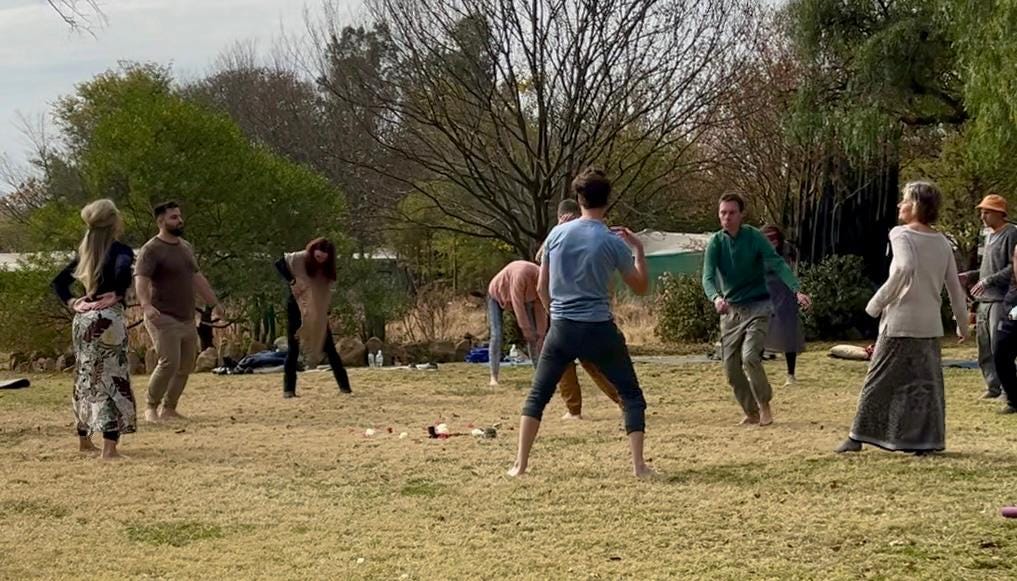
  • For  the love of movement

    For the love of movement

    In movement, we engage in a kind of alchemy of the past. We come into relation with ourselves, not as we want to be but as we actually are. This can be a very sobering coming home because we become aware of things we weren’t so connected to before.

    Way back when and all the way to now, we shut off those difficult experiences because they were too much, and no one was there to guide us. We had to learn to close off, to numb out, to disconnect in any way we could. Yet, those strategies did nothing to help the parts of us that got locked out.

    In movement, though, we can safely enter those places that are undigested, unresolved, and calling out for the light of awareness. I have been taught that being alone in your pain is not the same as being witnessed in it. There is something in the witnessing that allows us to release in a different way, as if we are longing to be seen in our whole being. Arguably, allowing that kind of seeing in is what heals us. We get the message from the outside that we’re okay, even in the worst of it.

    We really are okay even if we don’t feel that way. When we open to what we are a part of, there is no other option but to heal. Healing not as a deliberate act but rather a consequence of letting in that connectedness. Remembering a little at a time where we come from, what we are connected to, and what moves us. Not what we think should excite us, but what actually does. And it’s the body that tells us, that carries this truth to what author, Robert Greene calls our primal inclination—the thing that we don’t need to second guess; it just feels right.

    I came to dance in my twenties, at a time in my life when I was very shut down. I had chronic fatigue that I could not shake no matter how much I tried. Nothing worked, and few doctors had anything sensible to tell me. Movement for me was probably the first medicine that actually started to work. Not that there were overnight changes, but slowly, over time, I began to get into the hard-to-reach places and thaw some of the numb, shut down, frozen parts in me. It was this quality of movement that invited me to move with how I actually was, and not how I wanted to be, that made it possible to be with myself in a kinder way. It was the discovery of this kindness that I think, more than anything else, allowed the illness to move.

    How to Dance?

    If it’s not something you do often, it’s easy to start. Take any music you like and match it with your mood. If you feel down, don’t go straight to the upbeat stuff. Start where you are, letting go of any expectation for it to be different. You can make as many “mistakes” as you like, only to see that the only real mistake is to stay still. Follow your body, include your whole body, and be curious. Start with just a few minutes, anywhere, anytime.

  • Inside (and out) of the drama triangle

    Inside (and out) of the drama triangle

    Why its a foundational map everyone should know

    I’m often surprised how easy it is to slip into the drama triangle. The allure of the victim, the sudden pull of the villain or the griping impulse to be the hero. Each comes with it’s appeal, and gives a feeling of identity. I am this person who was wronged, or  I am the one who has to save the situation.  The problem isn’t  that we play these characters, its when we don’t know we do.

    We’ve all been there – stuck in a cycle of drama, finger-pointing and disempowerment. Whether it’s with a partner, coworker or friend, you may find yourself slipping into one of three toxic roles: the Victim, Persecutor (Villain)  or Rescuer (Hero). This is the drama triangle (first described by Stephen Karpman in the 1960s), and it keeps us trapped in repeating patterns. We can become totally lost in these  behaviours that ultimately drain vital life energy.

    How it works: The Victim feels powerless, blameless and at the mercy of circumstances. “Poor me, nothing’s my fault”, or it can be a lot subtler than this. The Villain points fingers, blames, criticises and puts others down.  “You did it!” And the Hero tries to “save the day” or fix the other two, while disempowering them further.

    Even if you have an awareness of how these play out in you, to me it’s a never ending job that doesn’t  not need to be fun or at the least entertaining.  Even in the most serious  moments we can still access some humour. Start by noticing when you slip into one of these roles. Is the helpless, helpless Victim voice taking over? “I just can’t do this, it’s impossible!” Or the bullying, blaming Persecutor? “This is a disaster because of your incompetence!” If so, pause. Breathe. Slow it down and bring some awareness to this part of you. Try be curious about it.

    You’re also acknowledging that its just a part of you. Its not out there, we do a U-turn and and see it  in ourselves. We can be interested in what’s actually happening. How are your actions (or inactions) contributing to the situation? Often there are valid fears, old wounds or unmet needs driving these roles. 

    Here’s an example: Sam erupted at his wife for leaving dishes in the sink. Villain, pointing fingers and making her wrong. But upon reflection, Sam realised he was defensive because he felt unappreciated and disrespected by her lack of effort (unmet need). His outburst was a cry for more consideration.

    Once you have that self-awareness, you can communicate your experience more clearly. Sam could say: “Dear, I get triggered when I see dishes piling up because it makes me feel disrespected and like my efforts don’t matter..”

    This is the antidote to the triangle: being vulnerable, sharing your perspective with “I” statements, and making requests for what you need. No Persecutors, no Victims. Just two humans working through life together.

    Of course, old habits die hard. Sam may still slip into drama roles. But with practice, he can catch himself sooner. “Ah, there’s that blaming Persecutor voice again. What’s really going on here?” Staying present with your experience.

    The triangle is seductive because it lets us think we’re justified in feeling powerless or lashing out. But it’s ultimately a distraction – an avoidance of taking responsibility or getting our real needs met. As we exit the triangle, we also see what changes are needed in us to create better outcomes ?

    In addition to the story in the mind, each role also has a somatic pattern. Bringing attention to the body is key. We notice what happens in the body as we play different parts. Where do you feel contractions or tension ? What is it like to stay a few moments with those sensations? and keep noticing …

    The Victim

    Energetically, playing the archetypal Victim feels defeated, collapsed and hopeless. There’s a sunken chest, slumped shoulders and lack of vital life force. You may notice shallow breathing, lack of grounding and feeling cut off from your centre.

    To work with this pattern somatically, start by consciously breathing into your body. Notice any held areas and breathe into them with curiosity. Gently engage your core by laying one hand on your belly. 

    As your breath deepens, you may feel a sense of being anchored in yourself, embodied rather than spaced out or overwhelmed. Stay present with physical sensations, letting the story in the mind fall away.

    The Villain

    When the Villain takes over, feel the tension and stuckness. There might be a tightness in the jaw, chest and shoulders as you prepare for battle. The body is braced, heart rate elevated and breath constricted. You’re flooded with stress hormones, ready to fight.

    One way to shift this pattern, is to slow your breath down and exhale longer than you inhale. Let your belly fully release with each out-breath. Unclench your hands and relax your face and tongue. Feel your jaw softening. Shake out any residual muscular armouring.  Alternatively,  let it get stronger, exaggerate the sensations and allow yourself to explore what movement wants to come here.

    As you stay present with the physical experience, you’ll notice in time things start to settle.

    The Hero (rescuer)

    Playing the Rescuer can keep one stuck in a kind of anxious overdrive. There’s a buzzing, hyper-aroused quality as you try to fix and save everyone else. You may be speaking quickly, mentally spinning and engaging in shallow chest breathing.  Many of these sensations may also overlap with the other roles.

    To ground and reorient, bring focus to the base of your spine and imagine sending roots deep into the earth below you. Breathe slowly into your low belly. Relax your shoulders and sense the earth beneath your feet. Peta Levine also suggests the “Voo” sound as way to regulate.  

    From this embodied state we can feel into and become aware of the  right amount of help needed for the situation. Also noting that the hero can also show up  as a distracting force,  rescuing us from uncomfortable emotions. Like being on social media too long, or watching endless TV series etc.

    The key is using the breath and body awareness as an anchor to what’s really  happening, we begin to see through the drama to reality as it is.

    The drama triangle is one of life’s most ubiquitous traps. But we all have the power to step out of the cycle into awareness. Its the game of being able to be in beginners mind, which always notices with curiosity as we’re in the patterns we don’t like to see.

  • What if you gave up on the  idea of change?

    What if you gave up on the idea of change?

    Embracing Responsibility Without Forcing Change

    What if there really wasn’t a problem to solve? What if everything as it is right now is all okay? How would that feel?

    When I try that idea on, my resistance comes on strong. What do you mean, no change? How on earth could it all be okay like this? I need to work for it to be better. There are so many things in my mind that need changing; it couldn’t possibly be okay like this. What about my agitation, anxiety, and apathy? That surely needs to change, right? Or what about the anger and frustrations I hold? That, too, must be a good candidate to put through recycling. All in all, I have work to do and better get to it! No time to waste.  That’s the director  in me right,  that strong voice that tells me I’m not even close to good enough without all these changes.   Renowned coach Jerry Colonna calls it the crow on his shoulder that doesn’t let up easily. Even this voice can be included as part of the phenomenon of unneeded change if we understand that its undertone is about safety and belonging.

    Notice what’s already changing. Life is change; it’s always changing. The one universal law we can count on is that change is constant. Without us needing change, we look around and change is happening. The problem is, it’s often not happening in the ways and timings we want.

    Imagine for a moment that you didn’t need to change. What’s that like to take that level of pressure off? And what if there was no problem with the worst of how you are—even that didn’t need to change. What if even the parts of you that you feel hold you back don’t need to change?  Notice how that feels to let yourself be in  your present imperfect shape.

    It’s a radically different way for those who have been in the change game long enough, undertaking endless workshops and change making processes. When I was young, I took all kinds of courses, some even going far enough as to promise enlightenment. When I look back at the common thread, I was almost always looking for ways to change. And it was often coming from a lack of acceptance for myself, and the conditions of my life.

    I am looking at change from a very different lens now, one that does not have the outcome in mind as a starting point. Well, you might say, what is the point of doing anything then? May as well just give up, if this is the person who I must accept. And that is my point—that’s like going to see a movie and disagreeing with the characters. He or she shouldn’t be like that. They’re not even close to good enough; they should definitely show up differently. That would be ludicrous, right? We don’t expect characters in stories to be different. Why hold that idea towards ourselves?

    What if you knew that you were good in your essence? Naturally like the rest of us—human and flawed but basically good. And at the essence, nothing you did or didn’t do would take away from that goodness.

    Now let’s look at the idea of radical responsibility, an idea I borrow from Diana Chapman. She says, in almost all situations, no matter the challenge, we can ask ourselves who we need to be in order to create a better outcome. For instance, you feel your partner doesn’t listen to you, or maybe understand you. Well, you could either put the pressure on them to change, or you could take a more radical approach and ask yourself who you would need to become in order for your partner/friend/colleague/boss, etc. to listen to you.  Its kinda crazy right, your boss doesn’t acknowledge your efforts, no problem;  what’s the change  in me that’s needed, not them ..

    Granted, you may become that person and they still legitimately don’t listen or change their behaviour. Then, stepping into those new shoes, maybe it’s more about listening and understanding yourself. This allows you to communicate your needs in a clear and non-reactive way. Or, who knows, it could be this newfound responsibility of becoming someone worth listening to that gets you airtime in unexpected places. The point is not making it about the other is a radical move.

    But then, what’s all this about not needing to change? How does that play into the world of responsibility and becoming?

    I think the most important task we have is to hold both as equally true. It’s true that we are fine the way we are, and it’s also true that we must change. Not necessarily because our aspirations for personal growth demand it, but rather because it is the very fabric of life. We must change and keep changing, because as we allow the change that naturally wants to happen, we move with life. But its not from force, judgement or any echo of the crow on your shoulder. I love Bruce Lee’s analogy “be like water.” Water is the ultimate shapeshifter.

    So, if not being listened to is your trigger, you might actually trick yourself into looking forward to the next time they don’t listen to you. Why? Because it tests you to see both how responsible you can be and also equally compassionate with yourself.

    Here are some practical steps to integrate responsibility and change:

    1. Mindful Self-Reflection:
      • Practice mindfulness during self-reflection. Observe your thoughts and actions without judgment, focusing on learning rather than self-punishment (or  the crow on your shoulder)
      • Practice: Set aside time daily for mindful reflection. Notice any harsh self-talk and consciously soften, and invite compassionate awareness.
    2. Gentle Goal-Setting:
      • Set realistic and compassionate goals that honour your current abilities and limitations.
      • Practice: When setting goals, ensure they are achievable and allow for mistakes. If a goal isn’t met, reflect on what you learned rather than leaning into the critic.
    3. Curiosity Over Judgment
      • Approach situations and feedback with curiosity instead of judgment. Ask “What can I learn?” rather than “What did I do wrong?”
      • Practice: In moments of disappointment or challenge, pause and ask yourself questions that promote understanding and growth.
    4. Self-Acceptance in Responsibility:
      • Accept your current state while taking responsibility for your actions. Recognise that growth is a process that doesn’t have an end point. We never actually get there!
      • Practice: Regularly affirm your worth and progress, even if it’s small. Celebrate your efforts and learnings as part of your journey.
  • Mind at large

    Mind at large

    After experiencing the realm of psychedelics, life is never quite the same. One has glimpsed something beyond ordinary awareness. Aldous Leonard Huxley, a pioneering philosopher, articulated this phenomenon in his landmark book, “The Doors of Perception,” back in the 1950s, a time when few in the Western world had been exposed to practices that had been commonplace in indigenous cultures.

    It’s a special kind of character to be able to express the experience of altered states as eloquently as Huxley did. He vividly describes his encounter with mescaline, derived from the peyote cactus, and how it radically shifted his perception of the world around him, opening him up to what he termed “Mind at Large” — a quality of consciousness always present but often obscured by our preoccupation with personal identity. Neuroscience calls it the default mode network, the preoccupation with everything self-related. When the network is overactive, it’s all about me, and that doesn’t tend to feel so good. It explains why we turn to mind-altering experiences; we’re longing for a break.

    In Huxley’s view, the role of the brain and nervous system is primarily protective, filtering out the overwhelming flood of sensory input to allow us to focus on what is practical and useful for survival. However, this filtering process also limits our perception of reality, confining us to a narrow understanding of ourselves and the world. Each of us is actually a mind at large, but for the sake of survival, Mind at Large needs to be funneled through the reducing valve of the brain and nervous system. The function is eliminative.

    These are Huxley’s key points about his experience with mescaline:

    1. The ability to remember and to “think straight” is little if at all reduced. (I cannot discover that I was then any stupider than I am at ordinary times.)

    2. Visual impressions are greatly intensified, and the eye recovers some of the perceptual innocence of childhood, when the sensum was not immediately and automatically subordinated to the concept.

    3. Interest in space is diminished, and interest in time falls almost to zero. Though the intellect remains unimpaired and though perception is enormously improved, the will suffers a profound change for the worse. The mescaline taker sees no reason for doing anything in particular and finds most of the causes for which, at ordinary times, he was prepared to act and suffer, profoundly uninteresting. He can’t be bothered with them, for the good reason that he has better things to think about.

    Interest in time falls almost to zero, and you are fundamentally changed at the level of will. The things that felt so important all of a sudden are less so. You are changed and yet still exactly the same. You still seem the same from the outside, but your attention has shifted. Carlos Castaneda also spoke about this phenomenon, that we’re caught up in what he called the “modality of the time.” And the main goal of the Nagual (shaman in the Mexican tradition) was to free his attention.

    So we lost sight of Big Mind, even though it was always there. But just a taste can remind us of what we’re connected to, of who really are. Part of the psychedelic experience is to see how much we’ve closed off and what we’re shutting out that could be vital to our life. But opening is not an all-or-nothing affair. The key is what trauma pioneer Peter Levine called “titrating” experience. There is simply no way we can do all of this in one go. We open gradually, each time digesting a piece of material and stabilizing. Opening, then closing, then opening a little more, then closing. It’s the natural rhythm of life; closing is as important as opening. We need to close sometimes; the problem is when we stay closed. It starts to feel a lot like freeze, stuckness, numbness. So we take our attention to these places slowly, carefully with resource and begin to unthaw, bringing fluidity to our system.

    Titration is about a little bit at a time. Opening to Huxley’s ultimate dimension is the medicine that gives us the space to heal. This Big Mind is what holds the pain with absolute acceptance. Not because it tries to, but because thats its nature: empty, open, kind.

    I think what Huxley is saying challenges us more than the experiencing of an altered state. Anyone can take a psychedelic and have their sense of self diminished enough to comprehend the ultimate landscape and the nature of mind. The bigger question is what we do with it. Because on the dose of mescaline, the answer is not much at all. We’re absolutely absorbed. But afterwards, how do we take this cleansed perspective back into life?

    I think part of the answer is being willing to inhabit our humanity. So when we’re back in the place we don’t want to be, can we allow ourselves to be there. To relax back into awareness and notice what experience is like without resistance. Life is messy. We are going to repeat the same old things, make mistakes, feel all kinds of emotions. But the recognizing of this open awareness in everyday life is what makes movement possible. We can learn to lean into this.

    The medicine of letting up the “restrictive valve” is to see that in absolute terms there is no problem to solve, while also seeing all the work to do. It’s the ultimate paradox, and the one in which we must live. Maybe it’s the adventure we signed up for that asks us to take this step into the unknown, and discovering our untapped resources along the way.

    More on integration of mind at large in part 2. Extra note to say there are many ways to enter an altered state that don’t depend on taking a substance. Breath-work, dance, meditation etc. All can facilitate the experience of Big mind.

    *artwork by InkTally.

  • How not to be hard on yourself

    How not to be hard on yourself

    What a strange question. How on earth could we be in a time where hardness toward oneself is not only normal but even celebrated? What do you mean you’re not hard on yourself? How on earth will you get through the day?

    ‘Hard’ comes in many forms. Hardness, as I am using it, is a kind of posturing. An unwillingness to let ourselves be as we are, a refusal to acknowledge the constellation of our inner system. It shouldn’t be this way; I should be better, be less of whatever it is that’s bothering us. Hard is a denial that, no matter the resistance you harbor, reality really is the way it is, including your response to it. No measure of a hard stance has or will ever change that.

    Tibetan-Buddhist nun Pema Chödrön said it as clearly as I’ve heard it – the need for change can be an act of violence toward ourselves. My interpretation is what a wonderful thing to want to change, but the same impulse can easily be co-opted into a kind of intolerance for the perceived ‘weaker’ aspects of who we are. So that we can override these parts in the name of change, with the cost of excluding parts of us that we’re not willing to meet. This is never a good thing. Think back to a time when you were excluded; how did you feel? Those parts of us we push away aren’t any different. They don’t just fade into the background; they become more demanding over time, and often force us into extreme behaviors.

    The nature of any system is that all parts belong. That doesn’t mean that all parts need to keep doing what they are doing. Clearly, we’re in the way of ourselves on many fronts. Change is needed, but how we change is the question. A Zen monk once said, “Take the step without making the one you’re on wrong.” Again, pointing to the possibility of inner compassion. And yet we’re not taught to do this; in many cases, the opposite is true. It’s often push or push harder.

    The default argument in my system goes something like, “Are you kidding me, I need that pressure. What will I do if I’m not beating myself up to get done what must be done? Softness is not going to get me there! I need to measure: Am I doing enough? Compare and contrast, and so it goes. Always an evaluation, whether in this moment I am doing what I should be doing. It’s binary. Either I’m meeting these inner standards, or something is wrong, and I need to be doing more. The focus is on doing, not being. What would happen if I did soften towards myself? Would I turn into a passive blob and not do anything or not get out of a rut or not become more of who I’m meant to be? Is hardness really the boss of these initiatives?

    My mother will say to me (now I see because she loves me so much!), “Are you busy? Or how busy are you?” With the underlying message that you can never really be too busy. The busier, the better, and so the internal dialogue goes something like, “Am I producing enough? I can be in ‘off’ time if there is such a thing, and the pressure is still there. Can you really afford to let yourself rest now? What about the massive backlog of things you were supposed to be doing, never mind forgotten dreams and aspirations? We’ll get to that later.

    What about the role of discipline then?

    In the ancient world, the cardinal virtues were courage, temperance, justice, and wisdom. They are more than a bite-size to chew on, more so a life’s work. Fast forward a few millennia, and the world is a very different place. How we interpret these virtues is surely going to be very different. From the point of view of the ‘hard’ nut western psyche, they could easily be confused as the next shiny object to conquer. I could foster temperance by being even harder on myself, or I could exercise self-control with kindness.

    So then, how not to be hard? One way is to be curious.

    Experience needs to be digested; everything has a cycle: beginning, middle, end. The same is true for experience; completion brings a sense of being settled. Often, our experiences don’t find completion. Instead, they get stuck somewhere in the cycle and lodge in the body, meaning we take them with us. To attend to these old stories in the body, we need to bring attention to those places. The genius of Peter Levine’s trauma work is that before touching on any of that, we find some stability in the present moment. We look around and remind ourselves that it’s a new moment now. We’re safe, and the evidence is all around. Chances are you are safe right now. As you look around your room, you offer your nervous system those cues of safety. We can remember the ground that’s holding us. None of this is as new-agey as it sounds. It’s a basic reality check. Right now, breath is moving through my body; I’m in a safe place, and everything is in a kind of order beyond my making.

    As we bring our attention to this cues of safety, we begin to feel a settling that comes with slowing down. This may even be your safest moment yet, and because of traumas of the past, you are behaving as if it were anything but. Even if you feel quite uneasy, anxious, sad, angry, or any other ‘negative’ experience, the most natural step is to find your ground first. It’s much easier to explore any feelings of unease after you’ve registered what feels safe for you. Now, can you be curious about any difficulty in your system? There is your composure rooted in kindness.