This is what I don’t want to write about. Even if I trick myself into writing the things I don’t want to share about regret, I still don’t want to write. More than anyone else seeing these things, it’s that I don’t want to see them myself. They are safely on the periphery, and that’s where I like them. When they are too close, they have the power to drown me.
And what’s the point? You can’t get it back. There’s no way of making right what went wrong. You’d have to be a little mad to look at that. It’s a total waste of time. Nothing can be done. Let’s just move forward.
That’s the voice of my control speaking. It’s the part of me that doesn’t see the utility in regret. While I understand that point of view, I want to paint a picture of what regret could be, what its purpose might be. Maybe we should even seek it out.
What drives me a little mad is when people say, “I have zero regrets.” Really? Nothing? It seems like pure hubris to me. You should have some regret, even if your material world is perfect. What about your relationships? And the most important one, the one with yourself. What have you allowed yourself, or stopped yourself from doing, that only with hindsight can you see would have been good for you? Hello, regret.
This is where regret is at its healthiest. Hindsight has this incredible way of illuminating the movements of the past. The psychologist Mark Freeman writes about the limits of our ability to see what’s happening while it’s happening. We are caught up in the immediacy of life, responding to what is in front of us, without knowing how things will turn out. The view is narrow. Only later, with the benefit of hindsight, do we begin to see the patterns and significance of what was happening. We live forward, but make meaning backward.
There’s something rather unfair about hindsight. We look back at decisions we made years ago with the knowledge and perspective we have now, and wonder how we could have been so foolish. But we weren’t standing where we are now. We were somewhere else entirely, inside the circumstances of our lives, with whatever understanding, resources and possibilities were available to us at the time.
Of course, even allowing ourselves to feel regret is a question. Isn’t it just backward driving? Regret can make us feel stuck and powerless. There is a part of me that won’t accept that things went the way they did, especially when it seems they could have been otherwise. I chose this supposedly wrong way, and now I have to live with the consequences.
Imagine if I hadn’t chosen. If someone had forced me into my bad choices, regret would start to lose its shape. If it was my action but not my choice, regret becomes a different proposition. But when it’s more clearly me, and only me, regret can eat you alive.
Looking back
Sometimes I think about how much of a difference different choices would have made to my life. Younger versions of me didn’t know another way. They pushed good opportunities away because who were they to take life, to be abundant, to move with what was meaningful? I think it just wasn’t in my DNA back then. I gave up like I was throwing in the towel.
Looking back from here, I think, how on earth could I? Look at the hardship I had to endure because of choices that now seem so obviously wrong.
When I connect with that twenty-something-year-old, I see that he was confused. He was a magical thinker as much as he was practical. And something that’s easy to forget: he was also deeply suffering. To him, this was the way. He didn’t know it would become a source of regret. These were the biggest, scariest steps he thought he had to take.
To give you a little insight into his world, he would find himself sitting in his consulting role under a pile of paperwork, drowning in fatigue. He would daydream about standing up and quietly walking off, having no idea where he was going, and never turning back. He wanted to leave everything: his phone, wallet, everything, and just walk off. Like there was something inside him needing that reassurance that if he did walk away, and gave what he imagined was full trust, something would catch him.
My mother said to me recently, “Remember all those apartments we used to own together?” How foolish we were to sell them.
That twenty-something-year-old spent the better part of a decade accumulating properties with a view to at some point not being stuck having to work. He did pretty well to collect almost ten, and that the banks kept loaning him money was remarkable. But, and this was a big but, he also carried the belief that he had missed all the good opportunities, and that what he had would never amount to much.
How on earth could he have thought that when he couldn’t have been more wrong? Sure, he had missed a fair number of good deals, but there were still plenty to come.
The problem was that he was facing a debilitating health crisis that would span over a decade. No matter what he threw at it, it wouldn’t go away. He was finding it increasingly harder to stay in the game and endure the everyday realities that would have led him towards his dream of being free from the shackles of employment.
By the time he was 28, he had had enough. He imagined another reality out there that somehow involved a path he would walk with the universe, as if the one he was walking wasn’t true.
So at 28, even when he had offers to stay on and work at one of South Africa’s most prestigious universities in Cape Town, he declined. Instead, he took the path of dropping it all. Having no weight, and trying to live life el cheapo and see how long he could last.
India was the place. And maybe, if he was lucky, he would find enlightenment.
He was also a product of his generation. That’s what you did back then if you were spiritually inclined. Go to India and find enlightenment. It was such a strong idea in his head, and seemed the ultimate antidote to his troubles. Forget about therapy, which probably would have done wonders for him. Go straight to the source, the problem underlying all others, and then maybe life would make more sense.
What he didn’t know about was me sitting here in the future, typing away these words. You fool, I would say to him. What on earth are you doing? Snap out of your magical thinking and look around you. Stay with it. You’re doing better than you think.
There is a lot I could say about that trip to India. Suffice to say that I spent almost two years there, and although I had some pretty incredible experiences, when I eventually came back unenlightened, and possibly a little worse for wear, I had to start again pretty much in the same place I had left off. I was not able to outrun myself. And I would only find out in time how much that decision cost me.
The person who made those choices
Often I think this is why we don’t want to look back. Regret tells us that something about now is wrong, that things could, and should, have been different. Just imagine where we could be now if we had done what seems so utterly obvious to us today.
As I’ve grown older, some regrets I thought I would never overcome have been replaced with acceptance. Sometimes acceptance has looked like, “Oh hell, here I am. Better get on with it.” There is also a sense of being more at peace with these younger versions of myself. It happened that way. Mostly, these days, I don’t have such a backward focus. But regret still happens. It can be triggered by something, and suddenly I’m back there again.
I wonder if holding onto regret can sometimes be a way of not acknowledging our younger selves. Could my younger self have done something differently? With what he had? With who he was?
This is where my inner critic finds cracks to get into. Of course I could have done it differently. All I had to do was stick it out and not run. But running was what I knew, and running was what I did.
Only when I listen a little longer do I hear something else. Running was also a courageous act for that young part of me. He wanted more than anything not to waste his life. He felt so stifled in what he was doing, like a glove that didn’t properly fit, as if he were living someone else’s life. If this was it, what was even the point? He wanted to feel alive more than anything else.
He carried many false ideas, but there also wasn’t anyone there to shake him out of them. When the time came to drop it all, it was as if all the adults in the room stood aside and watched him throw it all away. There is no doubt that he had loving parents, but they weren’t the kind who put firm enough boundaries around him. Whether they knew what he was doing was a mistake or not, they let him go. He had the freedom to drop it all, and that gave him a lot too.
If I were writing an intervention into this story, I would introduce a mentor. A masculine presence who could enter his life and wake him up a little. Not to shake the dreams out of him, but to say: stay where you are, and reach for help from where you are. His father loved him, but wasn’t good at asserting himself or giving a strong opinion. When he dropped it all, his father had very little to say. It’s easy to forget these details when looking back. But they matter. They help us understand the unfolding story.
If he knew then what I know now, would he still have followed the path he did? In my case, I don’t see any scenario in which he would. The first thing he would have done would have been to seek out a mentor, someone who could remind him that he was worth it. That maybe there was another way he hadn’t thought of.
He wanted a magic carpet. He had seen other people riding on them and thought that if he let it all go, life would pick him up and he would find himself riding on one too. It didn’t even need to be a glamorous one. He just wanted the feeling of not trying so hard.
But when I really look at that younger self, I begin to understand that, with what he had, he couldn’t have chosen differently. Not because there were no other possibilities. But for him to have chosen differently, something about him or his circumstances would have needed to be different. He would have needed to know what he didn’t know, to believe what he couldn’t yet believe, to have support he didn’t have.
I can look back and see another way. I can disagree with the decision. But I also have to take seriously the person who made it. When you understand the character, you know what’s driving them. You see the way they took as, in that moment, almost non-negotiable. No should-haves, no could-haves. More a study of why.
This doesn’t mean pretending the choices were good ones, or that there were no consequences. It means feeling the disappointment and the loss, rather than rushing to explain them away. And it takes work. We don’t arrive at acceptance simply by deciding things happened as they were meant to. Getting there takes blood, sweat and tears.
What I carry from that younger self feels a lot like wisdom. Through those experiences I learnt something I might not have learnt had things gone differently. I learnt what it means to truly back myself.
He didn’t know how to do that. Only through a series of failures did I get to a place where I could think: there is nothing else left but to try to believe in yourself. That you can make something from this raw material of life.
That may be the point of looking backwards: to discover what the past still has to offer us.
Sometimes I think we need to zoom out when regret takes hold. Mine wants to torture me with how much more money, security or opportunity I might have had. But it is remarkably selective in what it chooses to look at. It doesn’t seem so quick to consider what might have been worse.
What if my operating principle was that this life is just right? Not that it couldn’t have been better in the ways I wanted. Regret is very good at showing me that. But what if I asked a different question? What if this life is just right, not in the ways I might have chosen, but in the ways I need to grow? The conditions of my life may have been just right for my soul, for the lessons I came here to learn. Had things turned out differently, I might have missed them.
Regret, properly felt, is a courageous act. It asks us to turn towards something we would rather avoid, and to stay with the discomfort long enough to understand what it is telling us.
That younger version of me had a particular idea of trust. He imagined that if he let go of everything, something would catch him. He wanted life to take care of him. There was something beautiful in that longing, but it was tangled up with magical thinking. He was waiting for a magic carpet rather than finding a way to make something from where he was.
I wonder whether I have found a different kind of trust now. Not that everything will work out if I let go, but a confidence that I can meet what comes. That I can stay, ask for help, make mistakes, and still find a way to work with what I have. It’s not tangible, but I recognise it when I’m more connected to it. Somehow I’m less afraid, even when there is good reason to be.
I keep coming back to the idea of looking backwards in order to move forwards. There may be parts of our history we left behind, because we weren’t yet able to make sense of them. Something there may belong in the present.
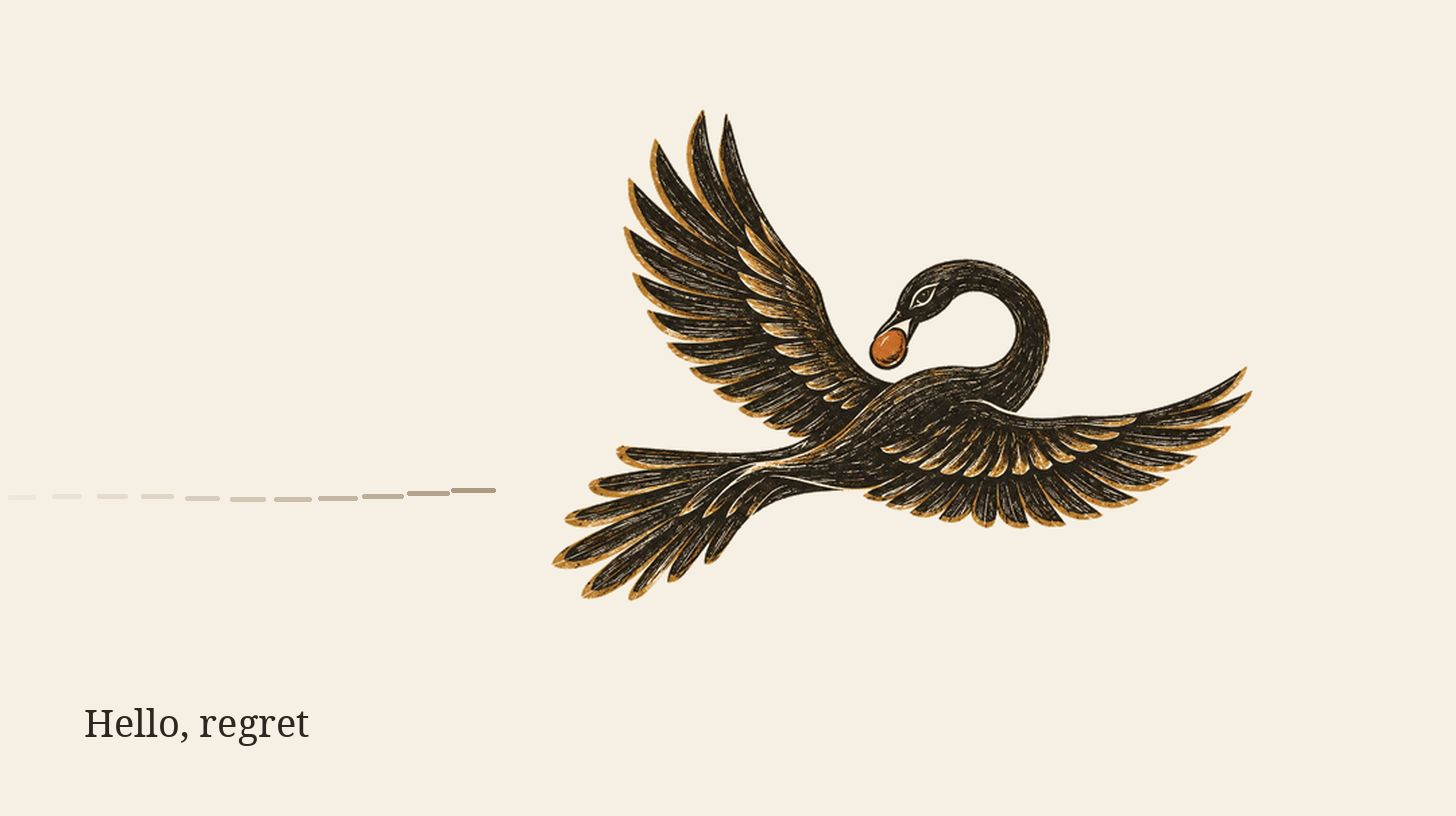
The Ghanaian concept of Sankofa gives us an image for this. The mythical bird turns its head backwards while continuing to fly forwards. We sometimes need to go back and get what we have forgotten. The past is not a place to live in, but there may be something there that belongs with us on the journey ahead.
We can think of this as a conversation between our past and future selves. We look back at who we were, with all we know now, and ask what we might learn. We might even hold a mirror up to our future selves. What would we want them to remember about this moment?
That’s also what the end of a year invites us to do: slow down enough to notice where we have been repeating ourselves, where old beliefs have been quietly directing us, and where something new has begun to emerge.
We are already the future selves our past selves were waiting for. Sometimes we have to go back to get something we need for the journey ahead.
We might as well not resist.
If this spoke to you, I’m running Sankofa again this December: 14 days of looking back to see forward, with three Zoom circles on 8, 15 and 22 December. You can see the details and join here.