Author: Ryan Klette

  • How I Carry My Father

    How I Carry My Father

    The things our fathers couldn’t finish become the things we must learn to stay with.

    My father used to say, “You gotta wanna.”

    He wrote it on scraps of wood and old boxes.

    Sometimes he’d sit with us while we absorbed those words, not really knowing what he meant by them at nine years old.

    That was his gospel, the belief that everything depended on will.

    He was right, in a way. But he left out the other half of the story:

    what happens when you don’t want to and life still asks you to stay?


    The Sander

    When I was a boy, he once brought home a manual sander, the kind with permanent sandpaper. But he never brought any wood.

    It sat unused for years, a monument to all the things that could have been made.

    He was always dreaming big, reaching for the next idea. The future seemed to call to him more strongly than the present. There were always possibilities on the horizon, but not always the small, patient steps needed to bring them into being.

    When I think about that sander now, what I feel is sadness.

    The potential was there. The tool was there. I was there.

    We could have built something together.

    Not because the table mattered, but because of what it would have meant. A father imagining something into existence with his son. Starting with a rough piece of wood and staying with it until it became something real.

    The older I get, the more I realise that children don’t just inherit what their parents build. They inherit what their parents believe is possible. Somehow that imagination never quite arrived between us. There were ideas, possibilities, beginnings. But not often the slow movement from start to finish.

    What I needed wasn’t the sander. I needed him beside me.


    The Shadow

    His father — my grandfather — was a maths professor in Zimbabwe. Brilliant, respected, exacting.

    That shadow must have weighed on him.

    But my father wasn’t an ordinary man standing next to an extraordinary one. In his younger years he won scholarships, engineering competitions, and was marked as someone going places. People liked him. He carried himself with a confidence that made the world seem open to him.

    And yet something happened.

    Instead of trying to measure up, he seemed to step sideways from the contest altogether.

    He had real endurance when it was on his own terms. He trained for years to earn his black belt in karate. He could push through pain, repetition and fatigue. The problem was never a lack of will.

    The problem was that his will worked best in freedom.

    When someone else set the terms — when the work wasn’t freely chosen, when conflict appeared, or when success required sustained exposure to judgment — something in him would retreat.

    I remember him helping my mother in her shop late into the night, cutting fabric by the metre. He did what needed to be done, but with a quiet resentment, as though obligation itself carried a weight he struggled to bear.

    Looking back, I don’t think effort was the issue. I think he found it difficult to stay in places where he felt measured, constrained, or exposed.

    That was the tragedy.

    Not that he lacked gifts, but that he couldn’t always bring those gifts fully into the world.


    The Battle of Will

    His will was both a gift and a trap.

    He resisted being told what to do, even when he agreed with what was being asked. Freedom mattered deeply to him. He wanted life to be chosen, not imposed.

    For a long time, I thought his struggle was perseverance. Now I think it was something more complicated.

    He could stay the course when the path felt like his own. But when commitment required surrendering control, enduring conflict, or risking failure in full view, something in him would pull away.

    There were so many thresholds he couldn’t quite cross because of that.

    Moments that asked not for more will, but for a different kind of strength — the willingness to remain present when the outcome was uncertain, when the work was unglamorous, or when success was no longer guaranteed.

    It was a constant tension between freedom and commitment, possibility and limitation, pride and exposure.

    And maybe that was the battle of his life.


    The Inheritance

    When I was younger, I thought this was the whole inheritance.

    The avoidance.

    The pride.

    The temptation to step away before failure could find me.

    But as I got older, I began to see that I had inherited other things too.

    My father loved people. He could walk into a room and feel at home. He was affectionate in a way many men of his generation were not. He told us he loved us. He hugged us. He made warmth seem natural.

    For years I compared him to his brother, who succeeded in many of the ways my father did not. It was easy to imagine that life would have been better with a different father — one who knew how to build wealth, navigate the world and get things right.

    Then after my grandfather died, my uncle confessed how sad he was that he had never really been able to hug his father.

    And suddenly the comparison wasn’t so simple.

    My father struggled with money. He struggled with business. He struggled to bring all of his gifts fully into the world.

    But love came easily to him.

    And I carry that too.


    The Turning

    That part of me still flinches from trying, afraid of what it might expose.

    But in honour of my father, I’ve spent my life walking toward the hard things —

    learning to stay, learning to fail, and learning to begin again.

    The mountains helped me.

    I found what I needed in vision quests — four days and nights alone on the land.

    I started when I was twenty-nine and finished when I was forty-three.

    My last was thirteen days on a mountain, alone.

    Those mountains taught me something my father couldn’t fully live.

    How to stay when every part of you wants to leave.

    How to sit with hunger, thirst, fear, and the voice that says you’re not enough.

    How to meet yourself at the threshold — and not turn away.

    They didn’t just teach me to stay.

    They taught me why to stay.

    For a long time I thought I went to the mountains to escape my inheritance.

    Now I think I went there to understand it.

    The question that followed me onto those mountains wasn’t really mine alone. It belonged to my father too. How do you stay when the path becomes difficult? How do you keep your heart open when life asks more of you than you want to give?

    The mountains didn’t erase those questions.

    They taught me how to sit inside them.


    The Completion

    For a long time I measured my father against his brother.

    My uncle succeeded in many of the ways my father did not. He built wealth, security and a life that looked successful from the outside. It was easy to imagine I would have been better off with him as a father.

    And maybe, in some ways, I would have been.

    I might have lived a more comfortable life. I might have worried less about money. I might have inherited more certainty about how the world works.

    But after my grandfather died, my uncle told my father how sad he was that he couldn’t even hug him.

    That stayed with me.

    Because whatever else my father struggled with, he never struggled to love us.

    He hugged us.

    He told us he loved us.

    He made affection seem natural.

    The older I get, the less interested I am in deciding which brother was successful.

    One built a life many people would want.

    The other gave me questions I couldn’t escape.

    Questions about meaning, perseverance, worth, belonging and what makes a life count.

    For years I carried my father’s failures.

    Now I see that I also carry his gifts.

    My growth has been to grow to love and want the father that I had.


    The Blessing

    If my father had given me a sander and sat beside me, if we’d made one small table together, our story might have been different.

    There are still parts of me that wonder about that life.

    The boy in me still imagines another version of his story — one where the scholarships led somewhere, where the business succeeded, where all that promise found its way into the world. Sometimes I imagine another father too. One who knew how to build foundations, who stayed with things to the end, who could have shown me how to turn possibility into reality.

    But that wasn’t the father I was given.

    I was given a man who was warm and affectionate. A man who loved people. A man who could make a stranger feel welcome. A man who carried both confidence and self-doubt, both promise and disappointment. A man who taught me as much through what he couldn’t do as through what he could.

    For years I carried my father’s failures.

    I carried the unfinished projects, the missed opportunities, the places where he turned away from himself. I carried the fear that I might do the same.

    But as I got older, I began to see something else.

    I carry his heart too.

    I carry his warmth, his generosity, his love of people. I carry his refusal to believe that money is the measure of a life. I carry the questions he left unanswered and the longing that drove him to keep searching.

    My growth has been to grow to love and want the father that I had.

    Not the father I imagined.

    Not the father who might have been.

    The father who was.

    Sometimes I still speak to him.

    Not because I need answers anymore, but because part of me is still walking with him.

    I find myself asking for his help.

    Help me get it right, Dad.

    Help me get it right for both of us.

    For the man who couldn’t always believe in his own gifts.

    For the boy who spent years trying to understand him.

    For the men who came before us who couldn’t quite stay when life became difficult, who couldn’t always trust themselves, who couldn’t always believe their lives mattered.

    Help me carry this inheritance well.

    I love you as you were.

    And I needed so much more.

    The older I get, the more I understand that both of those things are true.

    Thankfully, that so much more is now my responsibility.

    The threshold is mine to cross.

    The sander is still waiting.

  • 🌿 The Mandorla: Meeting in the Space Between

    🌿 The Mandorla: Meeting in the Space Between

    A dear teacher of mine, Caroline Carey, shares a profound process called the Mandorla. At first glance it seems simple: two overlapping circles. Each circle represents a different truth, a polarity that exists in our lives. One may be light, the other dark. One may carry longing, the other resistance. One may be the self that feels safe in belonging, the other the self that stands apart.

    The place where the circles overlap is the Mandorla — the almond-shaped middle ground. It is not about choosing one side over the other, but about daring to stand in the space between. Here, we can get to know both sides with curiosity, without having to reject or identify with just one.

    Caroline teaches that through The Magic of Mandorla we gain profound clarity on our core wound. Rather than treating this wound as an enemy, we come to see it as an ally — a place of hidden power that, when embraced, reveals our unique gift and the contribution we are here to make.

    It is known as the most powerful of (spiritual) religious experiences we can have in life. Mandorla is the place of poetry “And the fire and the rose are one.”  T. S Eliot


    An Ancient Symbol

    The Mandorla (also known as the Vesica Piscis) is one of the most ancient sacred symbols known. Two circles overlap to form the almond-shaped space that represents divine union and the meeting of opposites: earth and sky, masculine and feminine, ego and soul, physical and spiritual. The two circles sit inside a larger one, representing total existence.

    As Caroline reminds us, this is not abstract mysticism. It is a picture of our human task: to bridge spirit and matter, to live fully grounded in our bodies while also honouring the presence of soul.


    Why the Middle Matters

    When we step consciously into each circle, we can listen: What lives here? What voice wants to be heard? Each side carries its own stories, images, and sensations. By allowing them to express themselves, we begin to see more of the truth that lives in us.

    But when we are not conscious of this movement, it is easy to get swept into extremes. We may cling to light while denying shadow, or become trapped in fear while forgetting possibility. The circles drift apart, and life feels polarised, split, or stuck.

    The Mandorla reminds us there is another way: to pause in the overlap, to hold both truths at once, and to let something larger reveal itself.


    ✍️ A Mandorla Journaling Practice

    Here’s a simple way to try the Mandorla as a creative exercise:

    1. Take a blank sheet of paper and draw two overlapping circles.
    2. Identify a polarity you feel in your life right now (e.g. freedom/security, belonging/exile, hope/fear).
    3. Step into the first circle. Write down words, images, or sensations that belong to this side. Let it speak freely.
    4. Step into the second circle and do the same — give voice to what lives there.
    5. Continue adding to each circle over days or even weeks, until both sides feel fully represented.
    6. Then move into the almond-shaped middle space — the Mandorla. Ask:
      • What is needed for balance?
      • What do these two sides want me to know?
    7. Capture what arises — whether in words, images, or symbols.

    This practice helps us hold the tension of opposites with compassion, and often reveals new possibilities that neither side could see alone.


    A Story: Thandi’s Mandorla

    Thandi is a 32-year-old woman who often finds herself caught between two powerful forces. On one side, she longs for closeness. She watches friends laughing together, feels the ache of wanting to belong, and journals often about her dream of a deep, loving partnership.

    On the other side, she fears connection. Whenever someone gets too close, she notices panic rising — a tightening in her chest, a voice whispering, “If they really knew me, they’d leave.” This fear leads her to pull away, even from people she cares about.

    Living at these extremes is exhausting. Some weeks she pushes herself into social spaces, only to feel overwhelmed and withdraw. Other times she isolates for days, missing the very connection she longs for. It feels like she’s trapped in a loop.

    When Thandi tries the Mandorla process, she draws two overlapping circles.

    • Left Circle (Longing for Connection): She writes: “Warmth, laughter, safety, being seen.” She pastes in a magazine picture of two friends embracing. She notices a soft feeling in her chest when she lets herself imagine being included.
    • Right Circle (Fearing Connection): She writes: “Danger, rejection, too much.” She sketches a shadowy figure and adds, “If they know me, I’ll lose them.” The sensation here is tightness in her stomach.

    By spending time in each circle, Thandi begins to see that both sides have something to say. The longing protects her from loneliness. The fear protects her from being hurt. Neither is “wrong.”

    Finally, she turns to the Mandorla — the almond-shaped space in the middle. She asks each side: “What is needed for balance?”

    A new voice emerges: “I want to risk small steps. I don’t need to rush. I can let people in slowly, in ways that feel safe.”

    This insight doesn’t erase the polarity — but it shows her a way forward that honours both truths. She can listen to her longing and respect her fear. She can experiment with small, safe connections, practising trust one step at a time.

    In Caroline’s words, Thandi has begun to transform her core wound — the ache of disconnection — into the gift of compassionate presence with herself and others.


    Closing Thought

    At a time when our differences — of culture, politics, faith, or identity — threaten to divide us, the Mandorla offers a different possibility. It becomes not only a personal practice, but also a collective medicine: a way of building bridges where polarity seems insurmountable.

    The polarity between opposites can be destructive, but it can also be powerfully generative. By stepping into the space between, we learn empathy, humility, and courage — qualities that ripple out into our relationships, communities, and the wider world.

    The Mandorla is not about erasing differences or forcing harmony. It is about holding tension with compassion, listening to both sides of our inner life, and allowing something new to emerge. When we meet ourselves in the space between, we may find that what once felt like conflict becomes a doorway to transformation.

  • The Trap You Don’t Have to Escape From

    The Trap You Don’t Have to Escape From

    I felt that same old familiar feeling — rock and a hard place, as the saying goes. I’ve been there many, many times before. That place where there really doesn’t seem to be any movement either way. You’re damned.

    If you’re quiet enough, the answer will come. The movement will come.
    And it’s not a movement that comes from your mind.
    Hell, you can’t even take credit for it — because there’s nothing you did for it, except one big thing:

    Give up the struggle.

    Instead of trying to find your way out of the hard place, forcing solutions, trying to figure it all out, or arguing with life about why you’re in there in the first place, you do something so counterintuitive, so revolutionary, that your mind nearly jumps out of its own head.

    You simply stop the struggle.

    Imagine being tied up in one of those knots that only tightens the more you pull. That’s not far from the truth of the hard place. It’s as if the more we try to wrestle our way out, the deeper we dig the hole.

    But still — no one likes being stuck. And rightly so.

    Maybe I shouldn’t speak for everyone. I’ve met a few who seem to prefer stuckness because the idea of freedom is just too overwhelming.
    But most of us, I imagine, would much rather be free.
    And there’s nothing worse than the feeling of no movement.

    What I’m getting at is this: stuckness — the not-knowing, the confusion, the fog, the feeling lost — these are all forms of the hard place.
    And I don’t think any of that is actually the problem.

    In fact, I think we’d be wise to expect them.
    Being lost and confused is just part of being human.

    I watched this series recently — Somebody Somewhere — and I highly recommend it for the realness of its characters and the vulnerability of its story. There’s a line that changes the course of the main character Sam’s life. Her friend says to her:

    “No one knows what they’re doing.”

    Never has a truer word been spoken.
    None of us really know.
    We’re just making it up as we go, and stumbling as we go.

    But somehow, we’ve picked up this bad habit of expecting more from ourselves, like we ought to know better.
    Well, how on earth ought we to know more than we do?

    It’s a total delusion. We can only know what we know.
    And we’re going to get it wrong — again and again — and that does not need to be a problem.

    In fact, in my experience, the less I make it a problem, the more I learn.

    So back to that damned ditch I was in — that old familiar feeling. Can’t say yes, can’t say no. No obvious way to go.

    But something strange happened.

    I noticed I wasn’t so afraid of the feeling anymore.
    And a little voice inside reminded me:
    I am completely free to make my best move.

    I think of a tennis court — the best rallies, the impossible shots that come out of impossible angles.
    Even if the player loses the point, we love watching that kind of play — the creativity, the comeback, the refusal to give in.

    Something in us lights up when we see someone come back from a hard place.
    People rising out of difficulty, big or small — it’s an endless fascination.

    So maybe the point isn’t to wish for the rock and the hard place.

    But what if we could be just a little more grateful for those moments?
    Because they’re asking something of us — something more than we think we have.

    And the only way out… is in.
    To trust that it’s in you, in me, in everyone — and to learn to follow it.

  • Choosing the Hard Thing

    Choosing the Hard Thing

    If you are not prepared for the hard thing, given the opportunity, you’ll go for the easy option. Case in point: me.

    I intend to do this writing—the hard thing—and then I click on my browser and YouTube wants to tell me about F1, the easy thing. No disrespect towards the easy action. For some reason, I love to watch cars speed around a race track at ridiculous speeds. But it’s a very easy action to take. It takes much more to stay with the hard thing.

    Here are some thoughts about why that is so, and what we can do to make the harder thing easier. Which sounds like a kind of oxymoron, but what if the hard thing is what you really want? The choice that’s most likely to fill you up.

    Life is full of these hard actions we avoid doing. Once I’ve set my mind on something, guaranteed something else will come and pull me in a different direction. And let’s say I click on that seductive video, what’s the true cost, aside from the time lost? I’d argue it’s usually more than we think.

    What I forget is that it’s my life I’m giving—these small moments that make up the bigger arcs of time. That become the patterns that shape my future self.

    These small choices matter. At the same time, I can also err in the other direction, putting pressure on every moment to make it count. That’s its own form of insanity. So what does the middle ground look like? How do I do more of the hard things, without making life impossibly hard overall?

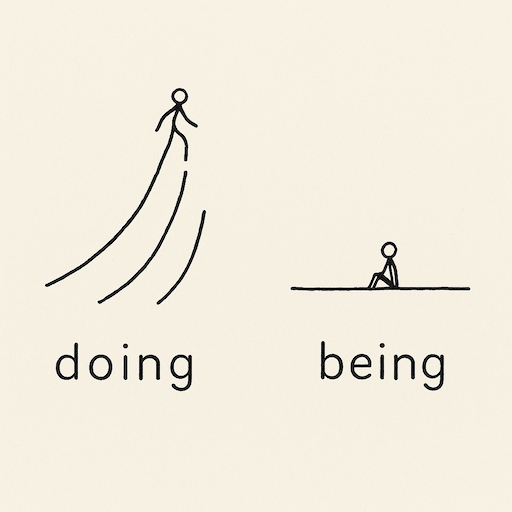
    One way is to give yourself permission to do nothing at all which, it turns out, is a lot harder than it seems. And possibly a step up from the F1 video that calls to the distractor parts of me. These moments of pause and non-doing are sometimes themselves expressions of the hard thing. Especially in modern society, where we have to contend with all the voices calling us lazy or unproductive. But what if the pause gives you the space to find the right action?

    Epictetus, in his way, warned against wishing life away. Even the waiting is part of it. You remember wanting to get there, on the way to the beach. But you wouldn’t actually want to fast-track it so that you didn’t have the experience of not being there yet. That part is just as valid as arriving—an expression of life.

    There are all kinds of moments, and we can’t hope to be doing the most productive thing in every one. But we can aim for the hard part: to stay with experience, especially when it isn’t the way we want it to be.

    “Don’t demand that things happen as you wish, but wish that they happen as they do happen, and you will go on well.” —Epictetus

    Back to my F1 example: does doing the hard thing mean I should never exchange ten minutes of my life for the experience of seeing cars go fast around a track? To my mind, not at all. We have a very real need for non-directional time, especially in a modern context. If it’s always about doing and achieving, we’re sure to run into crisis at some point.

    Time that’s playful in nature, or relaxing, or that disconnects us from the directional drive of our lives—that time is essential.

    There’s also no way to avoid getting distracted. I don’t imagine there’s anyone on this planet who’s 100% focused all the time. It’s more realistic to see distraction as a normal, even useful part of the day. You can wake up inside the distraction, and see what it’s trying to do for you.

    Most of the time, it’s just trying to take us away from discomfort or pain. But what if we stayed with the uncomfortable experience, even if that’s just our old friend boredom? It could be anything. What happens when you don’t resist it, but let it in for a moment—get to know it, even if just for 30 seconds? Doing nothing more than not trying to change your experience.

    As Gary Keller likes to say:
    “What’s the ONE Thing I can do such that by doing it, everything else will be easier or unnecessary?”


  • The Myth of Not Enough Time

    The Myth of Not Enough Time

    It’s been an unusually busy year for me—taking on a full year of both study and work. Feels like I’ve been mastering the art of juggling tasks and life. But even though, objectively, there are more things to get done, it’s not like I don’t have the time to do them. It’s my relationship with time that counts—the story I’m telling myself about how much of it I actually have.

    The story often goes something like: “I don’t have enough time.” or “there is too much to do”. But stories like these carries weight. It blinds me to the fact that I can often get done in ten minutes what, on another day, might take me an hour. What is that? It’s not hyper-productivity. It’s just… doing the thing in front of me, without resistance. Just doing it—without obsessing over how it turns out.

    It’s exactly like this writing. I could easily say, “I have no time for it,” with all the deadlines stacked up around me—but that’s not really true. When I’m just in it, it gets done in its own way. Not because I forced it, not because I nailed it, but because I didn’t get in the way of it. What I think I’m starting to learn is not to worry so much about the outcomes. There will be failures and shortcomings. Doing the thing that’s yours to do doesn’t insulate you from imperfection. But maybe those imperfections are something to celebrate. They’re proof we’re alive. That we’re actually in the business of living.

    And that’s not so much about getting somewhere—though sure, there are many places to get to. It’s more about being here. Its receptive, its listening, receiving and allowing that to move something in us. What wants to move beyond our thinking of things .. what if we did more of that ?

    But some parts of us just don’t know how to not be in fast gear. Those parts are carrying beliefs that might not even be ours. We inherit them—from ancestry, from culture, from the world. The idea that we need to keep doing, being busy to prove our worth. We often carry these beliefs without even knowing it. And for those parts of us that are trying to hold it all together, slowing down can feel like dying.

    “Busyness is not a proxy for productivity. It’s a sign that your time is being used carelessly.”
    — Cal Newport, Slow Productivity

    The big misconception is that slowing down means moving slower. Not true. You might even find yourself moving faster. It’s a state of mind.