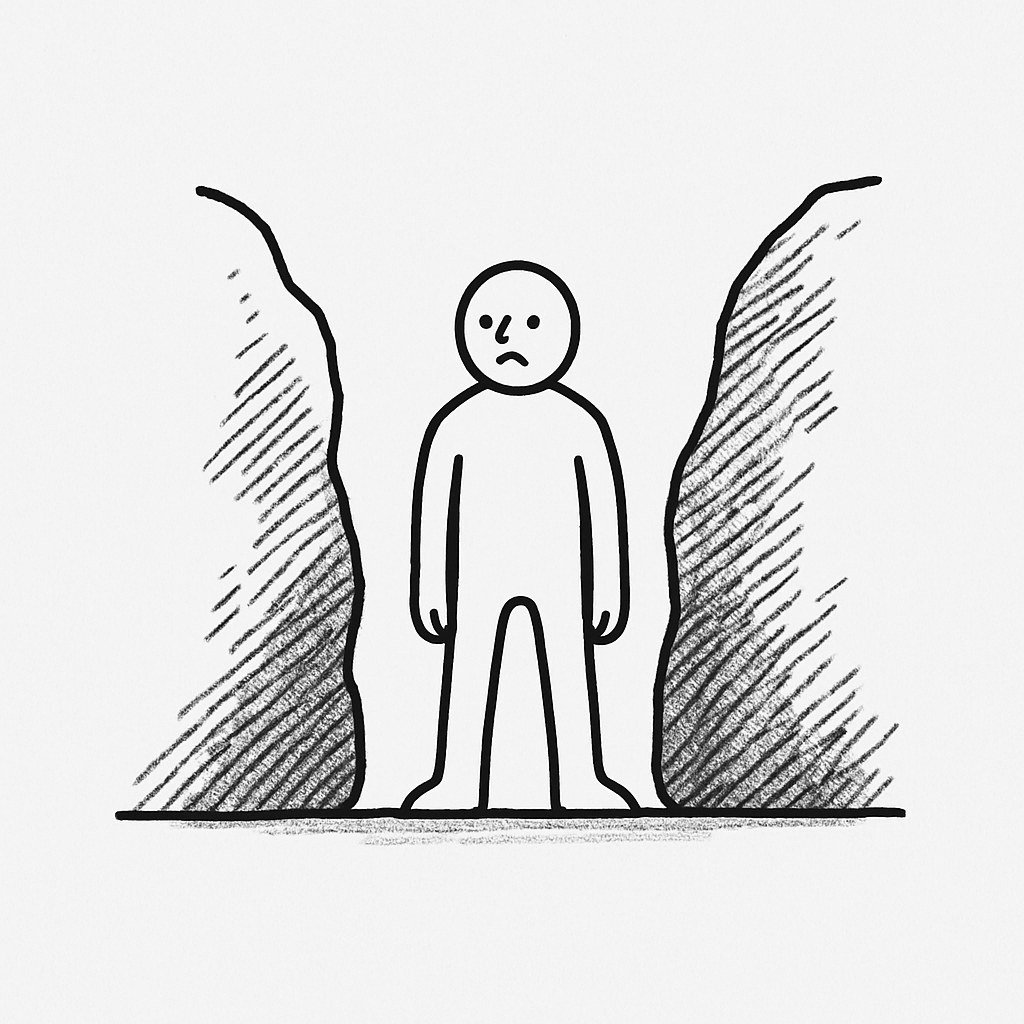
The things our fathers couldn’t finish become the things we must learn to stay with.
My father used to say, “You gotta wanna.”
He wrote it on scraps of wood and old boxes.
Sometimes he’d sit with us while we absorbed those words, not really knowing what he meant by them at nine years old.
That was his gospel, the belief that everything depended on will.
He was right, in a way. But he left out the other half of the story:
what happens when you don’t want to and life still asks you to stay?
The Sander
When I was a boy, he once brought home a manual sander, the kind with permanent sandpaper. But he never brought any wood.
It sat unused for years, a monument to all the things that could have been made.
He was always dreaming big, reaching for the next idea. The future seemed to call to him more strongly than the present. There were always possibilities on the horizon, but not always the small, patient steps needed to bring them into being.
When I think about that sander now, what I feel is sadness.
The potential was there. The tool was there. I was there.
We could have built something together.
Not because the table mattered, but because of what it would have meant. A father imagining something into existence with his son. Starting with a rough piece of wood and staying with it until it became something real.
The older I get, the more I realise that children don’t just inherit what their parents build. They inherit what their parents believe is possible. Somehow that imagination never quite arrived between us. There were ideas, possibilities, beginnings. But not often the slow movement from start to finish.
What I needed wasn’t the sander. I needed him beside me.
The Shadow
His father — my grandfather — was a maths professor in Zimbabwe. Brilliant, respected, exacting.
That shadow must have weighed on him.
But my father wasn’t an ordinary man standing next to an extraordinary one. In his younger years he won scholarships, engineering competitions, and was marked as someone going places. People liked him. He carried himself with a confidence that made the world seem open to him.
And yet something happened.
Instead of trying to measure up, he seemed to step sideways from the contest altogether.
He had real endurance when it was on his own terms. He trained for years to earn his black belt in karate. He could push through pain, repetition and fatigue. The problem was never a lack of will.
The problem was that his will worked best in freedom.
When someone else set the terms — when the work wasn’t freely chosen, when conflict appeared, or when success required sustained exposure to judgment — something in him would retreat.
I remember him helping my mother in her shop late into the night, cutting fabric by the metre. He did what needed to be done, but with a quiet resentment, as though obligation itself carried a weight he struggled to bear.
Looking back, I don’t think effort was the issue. I think he found it difficult to stay in places where he felt measured, constrained, or exposed.
That was the tragedy.
Not that he lacked gifts, but that he couldn’t always bring those gifts fully into the world.
The Battle of Will
His will was both a gift and a trap.
He resisted being told what to do, even when he agreed with what was being asked. Freedom mattered deeply to him. He wanted life to be chosen, not imposed.
For a long time, I thought his struggle was perseverance. Now I think it was something more complicated.
He could stay the course when the path felt like his own. But when commitment required surrendering control, enduring conflict, or risking failure in full view, something in him would pull away.
There were so many thresholds he couldn’t quite cross because of that.
Moments that asked not for more will, but for a different kind of strength — the willingness to remain present when the outcome was uncertain, when the work was unglamorous, or when success was no longer guaranteed.
It was a constant tension between freedom and commitment, possibility and limitation, pride and exposure.
And maybe that was the battle of his life.
The Inheritance
When I was younger, I thought this was the whole inheritance.
The avoidance.
The pride.
The temptation to step away before failure could find me.
But as I got older, I began to see that I had inherited other things too.
My father loved people. He could walk into a room and feel at home. He was affectionate in a way many men of his generation were not. He told us he loved us. He hugged us. He made warmth seem natural.
For years I compared him to his brother, who succeeded in many of the ways my father did not. It was easy to imagine that life would have been better with a different father — one who knew how to build wealth, navigate the world and get things right.
Then after my grandfather died, my uncle confessed how sad he was that he had never really been able to hug his father.
And suddenly the comparison wasn’t so simple.
My father struggled with money. He struggled with business. He struggled to bring all of his gifts fully into the world.
But love came easily to him.
And I carry that too.
The Turning
That part of me still flinches from trying, afraid of what it might expose.
But in honour of my father, I’ve spent my life walking toward the hard things —
learning to stay, learning to fail, and learning to begin again.
The mountains helped me.
I found what I needed in vision quests — four days and nights alone on the land.
I started when I was twenty-nine and finished when I was forty-three.
My last was thirteen days on a mountain, alone.
Those mountains taught me something my father couldn’t fully live.
How to stay when every part of you wants to leave.
How to sit with hunger, thirst, fear, and the voice that says you’re not enough.
How to meet yourself at the threshold — and not turn away.
They didn’t just teach me to stay.
They taught me why to stay.
For a long time I thought I went to the mountains to escape my inheritance.
Now I think I went there to understand it.
The question that followed me onto those mountains wasn’t really mine alone. It belonged to my father too. How do you stay when the path becomes difficult? How do you keep your heart open when life asks more of you than you want to give?
The mountains didn’t erase those questions.
They taught me how to sit inside them.
The Completion
For a long time I measured my father against his brother.
My uncle succeeded in many of the ways my father did not. He built wealth, security and a life that looked successful from the outside. It was easy to imagine I would have been better off with him as a father.
And maybe, in some ways, I would have been.
I might have lived a more comfortable life. I might have worried less about money. I might have inherited more certainty about how the world works.
But after my grandfather died, my uncle told my father how sad he was that he couldn’t even hug him.
That stayed with me.
Because whatever else my father struggled with, he never struggled to love us.
He hugged us.
He told us he loved us.
He made affection seem natural.
The older I get, the less interested I am in deciding which brother was successful.
One built a life many people would want.
The other gave me questions I couldn’t escape.
Questions about meaning, perseverance, worth, belonging and what makes a life count.
For years I carried my father’s failures.
Now I see that I also carry his gifts.
My growth has been to grow to love and want the father that I had.
The Blessing
If my father had given me a sander and sat beside me, if we’d made one small table together, our story might have been different.
There are still parts of me that wonder about that life.
The boy in me still imagines another version of his story — one where the scholarships led somewhere, where the business succeeded, where all that promise found its way into the world. Sometimes I imagine another father too. One who knew how to build foundations, who stayed with things to the end, who could have shown me how to turn possibility into reality.
But that wasn’t the father I was given.
I was given a man who was warm and affectionate. A man who loved people. A man who could make a stranger feel welcome. A man who carried both confidence and self-doubt, both promise and disappointment. A man who taught me as much through what he couldn’t do as through what he could.
For years I carried my father’s failures.
I carried the unfinished projects, the missed opportunities, the places where he turned away from himself. I carried the fear that I might do the same.
But as I got older, I began to see something else.
I carry his heart too.
I carry his warmth, his generosity, his love of people. I carry his refusal to believe that money is the measure of a life. I carry the questions he left unanswered and the longing that drove him to keep searching.
My growth has been to grow to love and want the father that I had.
Not the father I imagined.
Not the father who might have been.
The father who was.
Sometimes I still speak to him.
Not because I need answers anymore, but because part of me is still walking with him.
I find myself asking for his help.
Help me get it right, Dad.
Help me get it right for both of us.
For the man who couldn’t always believe in his own gifts.
For the boy who spent years trying to understand him.
For the men who came before us who couldn’t quite stay when life became difficult, who couldn’t always trust themselves, who couldn’t always believe their lives mattered.
Help me carry this inheritance well.
I love you as you were.
And I needed so much more.
The older I get, the more I understand that both of those things are true.
Thankfully, that so much more is now my responsibility.
The threshold is mine to cross.
The sander is still waiting.