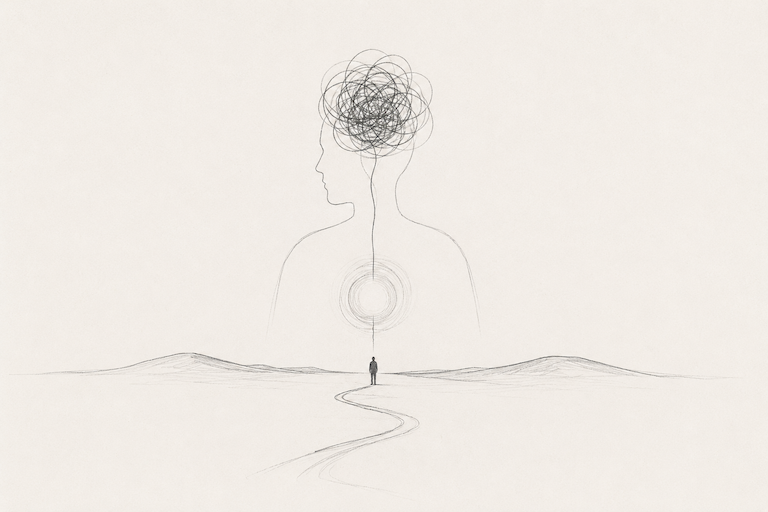
I have been doing some work at a rehab centre and, in my short stay, have learned a few things.
I look around and who surrounds me?
Addicts.
And I, as a non-addict, occupy a different position in their minds than they do in mine.
If you are like me and are termed a non-addict, then when you step into a space where people are in a program that teaches them to introduce themselves with:
“Hi, my name is Ryan and I am an alcoholic.”
it can feel confronting.
But I think I get some of why it’s important to start there.
Addiction is almost always associated with deception, manipulation, denial and lies. If you don’t start by naming the problem, there’s a good chance you’ll find a way around it.
But the more time I spend around addicts, the more I wonder whether some of these patterns belong not only to addiction, but to being human.
Sometimes personality itself starts looking like a manipulative structure, something that will do almost anything to get what it wants while avoiding what it fears, rejects or cannot bear to feel.
Often the suffering we experience seems tied to this push-pull dynamic. We have what we don’t want and we don’t have what we want. And so personality goes to great lengths trying to restore balance, usually by searching for relief in ways that often deepen the problem.
The 12 Steps begin with honesty for a reason.
Tell the truth or don’t tell the truth and pay for it.
Research increasingly shows that chronic dishonesty is not only hard on relationships, it is hard on the body. Martha Beck speaks about this. Coming from a Mormon background, she describes becoming deeply disconnected from herself while trying to live according to beliefs and norms that were not hers.
In order to stay connected to her community, she had to lie to herself.
She had to become someone she wasn’t and somehow hope that belonging would make it bearable.
Eventually she realised that if she continued betraying herself, she would become even sicker.
But what if you are not Martha Beck and you cannot leave?
Maybe you don’t have the strength, courage, resources or conditions to separate from your family or community in the ways you need to.
Maybe you continue to feel there is no other way to survive than to be inauthentic.
I keep thinking while writing:
What’s the point of words if they don’t actually belong to me?
At some point a substance or addiction can start to look like the only way out.
My point here is context.
Many of us were fortunate enough to express more of who we are and have that received and welcomed more often than not.
But almost everyone, I imagine, has experienced moments where they felt they could not fully be themselves.
We needed to become something else for someone else.
Maybe this is where the lie begins.
In those moments we are no longer ourselves.
The only possibility is starting with being honest with yourself.
Addiction begins making more sense to me from this angle.
Not as moral failure, but as an attempt to survive disconnection from self, others and life itself.
If we cannot feel connection to the life that is actually ours to live, we start searching for something else to live inside.
At another rehab centre they told me that as a non-addict I should be careful not to imply that I am the same as the residents.
And I understand that.
I have not lived the consequences many addicts have lived, and I do not want to minimise the reality of addiction.
But still, as I sit with addicts, the distinction between addict and non-addict starts falling away a little.
I am not immune.
Under different conditions I could have been sitting on the other side of the room.
I too know manipulation, avoidance, denial and self-deception.
I too have strategies for escaping myself.
I too can become trapped in rigid patterns that do not easily loosen simply because I want them to.
And yet I don’t think human beings fundamentally long for deceit or disconnection.
At some level I think most of us long for honesty, belonging, peace and authenticity.
The difficulty is that survival patterns do not disappear simply because conditions improve.
One of my favourite addictions is busyness, and culture rewards me for it.
The message is not:
“You have a problem.”
The message is:
“You’re on the right track. Push harder.”
As I sit with addicts, I see how my ego has the same capacity for deceit.
I am certainly not always honest with myself.
I have ways of avoiding myself.
This sounds a lot like addiction to me because even when I want to change, it’s often more accurate to say the pattern is running me than I am running it.
I could easily recite my own version of the first step:
I am powerless over my patterns.
This then leads me to Step Two.
The language of “Higher Power” points to something interesting.
Some traditions speak about this as Self, or the unbroken part of us. The part that remains intact beneath the conditioning, trauma and adaptations. The part in us that would not be possible to fully traumatise or break.
As we begin opening to this deeper self, we start connecting to something more honest and less defended.
Something that does not feel quite so separate from life or from other people.
Could this be part of what we mean when we say:
“Trust yourself?”
Not trusting every impulse.
Not trusting every fear.
Not trusting every craving.
But trusting the deeper ground beneath the trauma.
Learning to follow the place in you that is authentic and true.
Inviting everything in us that needs holding and attention to turn toward this more compassionate guide.
I think this is part of what the 12 Steps are pointing toward.
Not simply sobriety, but reconnection.
Learning to trust something in you that stands outside the fear, conditioning and survival patterns—and learning to follow that.
Maybe that is why these first steps feel so universal to me.
Not because everyone is an addict in the same way, but because so many of us know what it is like to become disconnected from ourselves and then organise our lives around avoiding that pain.
Part of me wants to join the addiction world and admit that, in my own way, I recognise myself there too, even if my forms are less visible and more culturally rewarded.
Some addictions are simply more visible than others.
Obviously some addictions are more destructive and extreme than others and need to be treated.
But take something like addiction to power.
It is often celebrated rather than questioned.
The more you accumulate, the more applause you receive.
Yet try asking someone deeply attached to power to stop.
Often they can’t.
Sometimes domination itself starts looking like addiction to me. The difference is simply where the suffering goes.
Put one of these people through a sincere 12-Step process and, if they are willing to look, their amends list may be every bit as long as a substance user’s.
There is maybe an even bigger problem underneath all of this.
It is not only that many of us become disconnected from ourselves or forced into adaptation.
It is also that this is not entirely a benign universe.
It can be a hostile one.
Survival has not always been easy for human beings.
We carry long histories of danger, violence, instability, uncertainty and exclusion.
You start wondering whether some of these traits—deception, hypervigilance, manipulation, denial—evolved alongside survival itself.
In some conditions these patterns were closer to protection than pathology.
Which makes the real question even harder.
How do we learn to trust ourselves not only when the going is good, but when things fall apart?
Maybe this is the deeper challenge.
Because it is easy to speak about authenticity and truth when life feels safe.
Much harder when survival feels threatened.
And if we look honestly at the world right now, uncertainty seems to be increasing rather than decreasing.
Economically, socially, politically, environmentally—many people feel less safe, not more.
Fear increases.
Instability increases.
And with that, the pull toward old survival strategies increases too.
It becomes harder to trust yourself.
Michael Mead speaks about this in many of the old stories he works with.
Often it is precisely in periods of difficulty and fragmentation that truth-telling becomes most important.
Not certainty or performance, or pretending everything is fine. But honesty.
The willingness to stop lying about who we are and where we are.
Maybe this is partly why recovery spaces move me the way they do.
Because beneath all the suffering and chaos, there is also something profoundly human happening there.
People, often with more difficult upbringings and harsher life conditions, gathering together to tell the truth.
And in a culture that rewards image, performance, productivity, avoidance and endless striving, that starts to feel radical.
In that sense, rehabs and recovery centres can almost feel like strange little beacons of light.
Places where people come to admit powerlessness, face themselves honestly, and slowly reconnect to something more real.
That feels like a lesson far bigger than addiction.