
What the Critic Doesn’t See
The more coaching and therapy work I do, the less surprised I am by the invisibility of the inner critic.
It has become so normalised that we hardly notice it anymore.
If you don’t have one and it’s not giving you or other people a hard time, then what are you even doing here?
It’s almost as if we show our grit and worth by enduring this harsh voice. Maybe more importantly, by taking its comments to heart.
Recently I was coaching a woman in her sixties who works in sales. One of the consistent pieces of feedback she receives from her managers and colleagues is that she needs to slow down. She can’t keep working at such a frantic pace.
The problem is she doesn’t know how to.
If she is busy on the inside then she is showing her worth. And she has to keep showing her worth because somewhere along the way she lost touch with her sense of value.
When I worked with her recently she had just been given two warnings on the same day for gross negligence. She had quoted the wrong amount to a customer which, in her position, is about the worst mistake you can make.
What struck me wasn’t the mistake itself.
It was the reaction.
A double warning for the same incident can hardly be legal, but you get a sense of where it comes from. It’s not as if the critic hasn’t got a point. The mistake is far from ideal.
But the reaction to it is almost laughable.
Does the critic really think this is what changes behaviour?
Because what I noticed was that she immediately doubled down on her own critic. More pressure. More vigilance. More self-monitoring. Which, ironically, made her even more likely to make another mistake.
One of the things the critic so often assumes is that somehow the person could have done better.
In this case she was spending every day trying to avoid mistakes like the plague. She wasn’t careless. She wasn’t lazy. She wasn’t indifferent.
She was already trying.
Which is why I asked her:
“What does a good mistake look like?”
She almost fell off her chair.
There is no such thing.
At least not from the critic’s perspective.
The critic that shows up in her boss wants things done a certain way. And as much as there is value in standards, they can eventually begin to suffocate the many different ways human beings reach the same goal.
The older I get the more interested I become in what sits underneath this voice.
Whenever I move closer to something meaningful, something else in me often wants to move me away from it.
Anything but that.
Anything but the possibility of being rejected, humiliated, ignored, overlooked, embarrassed, exposed or found wanting.
The critic, you could say, is the part that protects us from that old hurt.
The proud defender of shame.
Its motto is simple:
Never again.
Never again will we let ourselves feel that helpless.
Never again will we feel that worthless.
Never again will we be caught off guard.
Never again.
And because it is trying to protect us, it doesn’t feel like a voice at all.
It feels like the truth.
What it says goes.
To ignore it can almost feel reckless.
Of course I can’t let go of the guard rails.
Of course I can’t trust myself.
Look where that got me before.
But one of the biggest blind spots of the critic is that it often doesn’t see that its own strategies don’t prevent failure.
Quite often they rush us closer to it.
I remember going for an interview at my third high school.
My parents had recently divorced. I’d come back from a boarding school I loved because we could no longer afford it. I was struggling with acne, low self-worth and all the confusion that comes with being a teenager.
I sat down in the office of the man who would become my headmaster.
The first thing he said to me was:
“You’re a sloucher.”
Now to be fair, I was slouching in the chair.
But the furthest thing I was, was a sloucher.
I was insecure.
I felt like I didn’t belong.
I was trying to disappear.
What interests me now is that I can find compassion for both the boy and the headmaster.
The boy who did not know how to take space.
The headmaster that did not know how to give space.
Such is the power of the critic that in the headmaster’s mind this was probably the way young people improve.
Point out what is wrong.
Correct it.
Repeat as necessary.
Eventually they will become better.
But that isn’t usually what happens.
The boy doesn’t become stronger.
He becomes smaller.
He receives confirmation that there is something wrong with him.
Soon enough he won’t even need the headmaster to tell the story anymore.
He will tell it to himself.
And that is often what the critic accomplishes.
Not a better student.
A more diminished one.
My point here isn’t that critics are bad.
In fact, some of them have probably saved us from embarrassment, humiliation and rejection more times than we’ll ever know.
My point is that they often don’t see the cost of their own strategies.
Next week I’ll write a little more about the different kinds of critics that show up in our lives and the roles they play.
But maybe the even more interesting thing is that not all critics are the same.
Parts on Paper Journalling Group: Meeting the Critic
Over the next few weeks I’ll introduce each member of the Council of Critics and share some simple journalling prompts to help you get to know these voices.
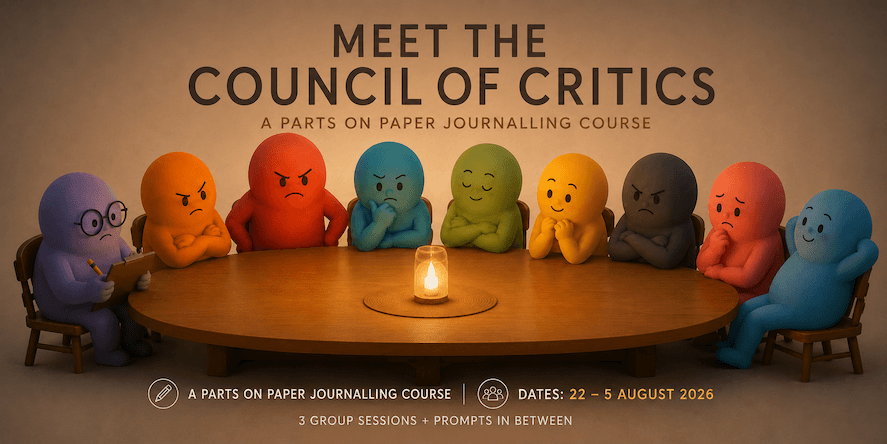
If this speaks to you, you’re welcome to join Parts on Paper: Meet the Council of Critics—a three-week online journalling journey. Together we’ll begin to recognise these inner critics, understand what they’re trying to protect, and find a different way of relating to them.
The goal isn’t to get rid of your inner critic. It’s to understand it. And in doing so, remember the Self in us that’s calmer, wiser, and better able to lead.
More information here.