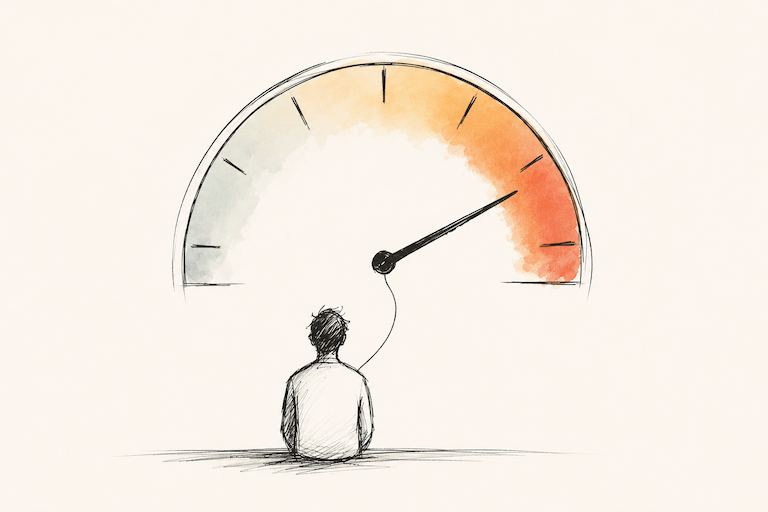
I came across one of the most interesting ideas recently from Sarah Bergenfield speaking about the neuroscience of uncertainty.
It’s not a new idea she is putting forward, but no less important for that.
And why should we care about monitoring uncertainty?
Because “I don’t know what to do” is one of the most uncomfortable places a human being can find themselves.
At some level, I think most of us are trying to avoid that experience.
We want to feel like we are managing uncertainty. We kind of like the idea of not knowing exactly what comes next, but only if we have enough confidence in ourselves to handle whatever arrives. There is nothing worse than having it thrust upon you and feeling like you don’t have enough of what you need to deal with it.
The “in over your head” experience.
We are right to want some control, some degree of certainty. Otherwise life would simply be too much.
Sarah’s description of uncertainty reminded me of something Aldous Huxley wrote many years ago in The Doors of Perception.
(I explored Huxley’s ideas in more depth in an earlier essay, Cleansed Perspective, for those interested in going further down that rabbit hole.)
Huxley proposed that the brain and nervous system function less like a camera and more like a filter.
Reality is simply too vast, too complex and too full of information for us to take it all in. So the nervous system narrows our experience down to what appears most relevant for survival.
In Huxley’s language, we are each connected to what he called “Mind at Large”—a reality far bigger than the small slice we normally perceive. But for practical purposes, that larger reality has to be funnelled through what he called the “reducing valve” of the brain and nervous system.
The purpose of this filtering isn’t truth.
It’s survival.
From this perspective, the brain is constantly making predictions about what comes next. Most of the time those predictions are accurate enough that life feels manageable. We know where we are going, who we can trust, what tomorrow is likely to bring.
But when reality stops matching the prediction, uncertainty rises.
And from an evolutionary perspective, that makes perfect sense. Not knowing what is coming next could be dangerous. Better to predict, prepare and stay one step ahead.
The challenge is that the same uncertainty that signals danger can also signal growth.
The nervous system often struggles to distinguish between the two.
That being said, not knowing can also be one of the highest expressions of our creativity.
It is in not knowing that we make space for whatever new thing life is trying to birth through us.
A relationship.
A business.
A book.
A difficult conversation.
A new version of ourselves.
From a mythological point of view, whatever is waiting to come into being arrives through those willing to remain an empty vessel for a while.
None of these emerge from certainty.
They emerge from a willingness to stand in territory that cannot yet be fully mapped.
The same uncertainty that our nervous system experiences as danger can, at times, be the very doorway through which life is trying to move us forward.
Uncertainty is not one thing or another.
We want to find whatever certainty we can and rest in that while simultaneously making space for the bigger reality that life itself is a profoundly uncertain place.
What’s even more interesting to me is that uncertainty affects us differently.
Not only do different people respond differently to uncertainty, but our own inner world can become full of contradictions around it.
One part may become excited.
Another becomes terrified.
One part freezes.
Another immediately starts making plans.
One part wants guarantees.
Another wants adventure.
Whatever the constellation of our inner experience, it seems unlikely that anything moves us quite as much as uncertainty.
Much of psychology focuses on external triggers.
That person upset me.
That event stressed me.
That conversation made me anxious.
And of course that happens.
But what if our state shifts are not always driven by other people?
What if sometimes our uncertainty meter is simply running higher than usual?
Without anything dramatic happening, we may find ourselves more tense, more contracted, more vigilant. A little more on edge than normal.
And this inevitably shapes the lens through which we experience our day.
Imagine you are in a fight with your partner.
They storm out and leave.
Your system is now not only responding to the conflict itself but also to the uncertainty surrounding it.
When will they come back?
Will they come back?
What does this mean?
The mind starts trying to close the gap.
To resolve the uncertainty.
To regain a sense of control.
What’s fascinating is how much of this happens automatically.
The question for me is not how do we eliminate uncertainty.
The question is how do we grow our capacity to be with it without becoming reckless.
This is where parts work becomes useful.
Because uncertainty doesn’t land on neutral ground.
We all have histories.
Some of us grew up in homes where the world felt dangerous and unpredictable.
Others grew up around chaos, where uncertainty was simply normal.
Some of us learned to control.
Some learned to avoid.
Some learned to perform.
Some learned to disappear.
All of this influences how we respond when uncertainty appears.
If I listen carefully enough to the voices inside me, I often hear a range of different perspectives.
One urges caution.
Another sees possibility.
Another remembers what happened last time.
Another wants to leap.
Perhaps the task isn’t to silence uncertainty.
Perhaps it is to listen carefully enough to hear who is speaking.
The beautiful thing is that we are not limited to any one of these voices.
There is something larger that can listen to them all.
Huxley called it Mind at Large.
Other traditions speak of awareness, presence, Self or soul.
Whatever language we use, most of us have touched it at some point.
The place in us that can remain open when the rest of the system contracts.
The place that doesn’t need certainty in order to be present.
The more I think about it, the more useful the uncertainty meter becomes.
Not because it tells us what to do.
But because it helps us understand what is happening.
One of the first questions we can ask is:
What is influencing my meter right now?
The most immediate zone is the self.
Our own body.
Our own thoughts.
Our own internal world.
A strange pain appears in the body.
A symptom we don’t understand.
A sensation we weren’t expecting.
Suddenly uncertainty enters.
The mind begins trying to make sense of it.
What does this mean?
Is something wrong?
Do I need to worry?
The uncertainty meter starts climbing.
From there we move outward.
Into our immediate environment.
The people we live with.
The places we spend our time.
I know someone whose uncertainty meter was constantly activated by a building project next door.
The noise wasn’t the problem.
The uncertainty was.
How long will this continue?
What will happen next?
When will it stop?
The nervous system struggles when there is no predictable end point.
Then we move outward again.
Family.
Relationships.
Community.
Perhaps it is a change at work.
A new teacher at your child’s school.
A shift in a friendship.
A parent becoming ill.
Every circle we belong to has the potential to increase or decrease our sense of certainty.
And then we arrive at the widest circle of all.
The world itself.
Wars.
Politics.
Economic instability.
Social change.
To whatever extent we allow the world in, it too influences the meter.
What strikes me is that we all have different sensitivities.
The same event may barely register for one person and completely destabilise another.
A war on the other side of the world.
A change at work.
A strange sensation in the body.
A child struggling at school.
The uncertainty is not only in the event.
It is in the relationship between the event and the nervous system experiencing it.
There is no universal uncertainty meter.
Only our uncertainty meter.
And perhaps that is where regulation begins.
Not with fixing.
Not with certainty.
But with noticing.
My uncertainty meter is high today.
Something in my system is responding.
Something in me is looking for safety.
Just naming it can create a little more space.
A little more compassion.
A little less identification with the stories uncertainty generates.
Perhaps the goal isn’t to eliminate uncertainty.
Perhaps the goal is simply to become more aware of our relationship with it.
To know when the meter is rising.
To understand what is influencing it.
And to remember that there is something in us larger than the uncertainty itself.
To know when the meter is rising is already the beginning of wisdom.
If you’re interested in exploring these themes further, I write regularly on Substack about uncertainty, parts work, identity, belonging, recovery, and the many ways we learn to navigate being human.
I’ll also be facilitating a small online Parts on Paper group starting on 24 June.
We’ll be exploring many of these themes through reflective writing, conversation and a series of prompts designed to help us hear the different voices that emerge when life becomes uncertain.
The aim is to become more intimate with the ways we have learned to survive.
To understand the protectors, strategies and assumptions that shape our lives from behind the scenes.
And perhaps, in the words of Suleika Jaouad, to become a little more creative with our survival.
To discover new possibilities for responding to life beyond the patterns we inherited, learned or developed out of necessity.
If you’re interested in joining the group, drop me an email and I’ll send you the details.