Category: Behaviour change

  • Reimagining change

    Reimagining change

    Try as we might, we don’t change with good intentions alone.  It’s actually impossible not to change. We are changing every moment. Nothing ever stays still. The question is more how do we change in the ways that we want. I am writing this with myself in mind, what I notice about my own internal landscape.

    Part of the problem are my intentions because I am so often wrong about things so why would I assume to be right about the direction of change. In some ways its easy because outside feedback and inner intuitions find a meeting point. But perhaps in the most important ways, I simply have no idea about what I actually need and what a good direction looks like. For example, for a long time I thought corporate wasn’t the place for me to work. Turns out many years later I am happy to have corporate clients and work in an environment I once thought was unfit. In that frame I was convinced I knew what was right. What now then ? How might I be wrong about what I think I need or the direction I think my life should be going in? what does it feel like to relax the knowing? 

     It’s  often true that the part in me that wants the change is one who feels wounded or burdened in  some way. In other words the impetus to change is coming from a condition of the past.  It’s not actually a wish from an integrated self but rather an expression of unmet pain. A part that needs things a certain way in order to feel better, or a part that might be pushing away change in order to protect the hurt ones. 

    When a wounded part is not in control, the Self is free to move with the world in full acceptance of life as it is. One would not imagine needing to give advice about how to change to such a self. Without the burden, the self is open and responsive to life and the change that is happening all by itself. That self can live  in the moment and be fully available to potentials that just weren’t available to the other parts. The essential point is that all parts need to be included though, (as an ongoing practice) in order to embody the Self that can lead. The Self that can trust life.  

    The change is then more about letting go than it is trying to get something. To let go is to give space because space is what heals. It’s when we feel we have space to move that movement happens. As long as we feel stuck, it’s like nothing can breathe and if nothing can breathe we keep doing the same things, not learning from our mistakes and the mistakes of generations behind us. 

    Maybe a better way of framing change is aiming to stay as you are. Big leap maybe, staying the same is also the kind of challenge we signed up for. Born into a world where we were taught to be other than what we are.

    I think the hero’s journey is to come back to you as you and from that place, listen. So you might try this on for an idea – don’t change, rather let change happen by giving space to all of who you are.

  • Locating self

    Locating self

    When we are standing in the truth of who we are it seems kind of ridiculous that we run these patterns and  yet we do. Whats more is we see they are  not so easy to stop. They don’t respond to force or will very well although there is also no need to get rid of intention. We  need to stay close to our will and keep sharpening our focus but this alone can only take us so far mostly because will is unreliable.  One day we may feel totally inspired to change and do all we can to make that happen while the next we might not want to move a bone in the body. Ok a little extreme but  you get my point, we can’t count  on will.

    We need something else to help us find more creative ways in dealing with unconscious and automatic behaviors that can hold us back in fundamental ways or just make our lives harder than they need to be. I am not suggesting in any way that we need to transcend our humanity, that would be even less productive then autopilot.  There are always going to be growing points, stretches we need to make so we can evolve our lives. As Joseph Campbell said, its our imperfections that make us beautiful. The Gods  he said, are jealous of us for that reason. Its whats gives life juice and also a reservoir of life energy. Not discounting physical health but if we feel depleted and in need of energy, its one of the first things to check – what behaviors am I running that may be draining my energy ? 

    This is why we explore personality, the shape and condition we find ourselves in.  To the earlier point, the key partner for intention is kind attention. Its in the willingness to see ourselves as we are that makes change more possible.  When we pay attention to ourselves, we give space for intuition and an inner movement that opens us to goodness. Not goodness that avoids pain but goodness that moves us through it.

  • Mindset 2

    Mindset 2

    We all know mindset one. That’s binary thinking. On – off. Failure success. The  one that is constantly on our case for not being enough. The controller inside that tells us when to start and end.

    In an addiction, mindset 1 would say once crossed the line  doomed to fail. No turning back . What’s the point. Loose even more control when in the failure zone. Just let it all go and deal with the consequences another time. Its binary and not able to operate in shades of grey. Mindset 1 keeps us in a narrow gaze and not open to the life intelligence in and around.   In this perspective we don’t see  that there can be success in failure and the other way around. It’s simply not so clear cut.

    Mindset 2 is a completely different perspective with very different attitudes about what is possible in any given moment. So in an addiction for instance, we would not need to draw the line between success and failure.  In this mindset its more about playing the game and that means staying in the body. If we find ourselves doing too much of something, this mindset would enable us to wake up and come back to centre at what ever point in the addictive cycle we found ourselves in. It thrives in the grey because life mostly happens in this zone anyway. 

    Mindset 2 is founded in kindness and celebrates micro victories. We can build a new character in ourselves based on these little wins. A character that already embodies all the strength, courage and resources to live a life of authenticity and mystery.

    Ask yourself, did you ever get anywhere by being hard on yourself ? Does that really work when you think through it?

    In my experience all it does is make an enemy out of myself which leads to a whole host of problems I don’t already need.

    Kindness on the other hand means we can be how we are for once without the incessant voices in our heads about how I think I ought to be or how  I’m not good enough or whatever story is running in one’s head. Kindness lets it be just the way it is and relies on all the creative forces  in life to find all the right movements.  

    It’s like we really don’t need to force ourselves into shape. The shape can emerge organically with our attention rooted in kind awareness.  Always coming back to giving a holding space to you first. If we can hold the best and worst  in us, then I think quite naturally we move towards health on all levels. Our work  is to stay in the game and that means we need to start checking  in more.  Staying with the experience in the body. Playing close attention to the sensations we feel and especially the ones that we tend to run from.

    From this place, rooted in kindness but also firmness, we are resourced in all the ways we need. We give ourselves the best chance to catch the life that is only ours to live.

  • 5 stages of grief

    5 stages of grief

    Greg Braden said on the London real channel recently that we are in a collective process of grief right now, whether people know it or not.

    We have lost our way of life, our routines, meeting points and ability to gather socially. Being social creatures, this is a significant loss. Although many people are recognsing many positive aspects from the lock down ( for me whats most apparent is clean air and hearing the birds), we should also be paying attention to deeper emotional experiences that we are going through in both personal and collective capacities.

    That means first of all acknowledging that grief is in the room. We might look to welcome grief like an old friend, she belongs just as she is. I use the feminine because we’re speaking about strong emotion and its the feminine that reminds us how to hold this – with kind attention.

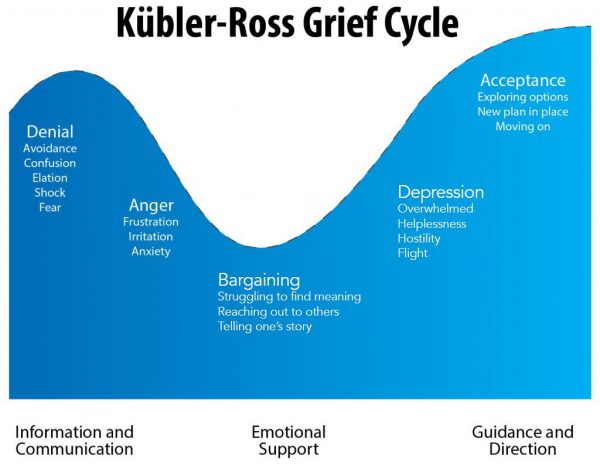
    The next important piece of Braden’s message is a reference to Elizabath Kubler-Ross who has written and researched extensively on death and dying . She identified the stages of grieving that we move through when faced with loss. In this instance, the loss is about our ways of being and moving in the world and ability to meet socially, in person as a central theme. The stages are really useful because we can better orient ourselves emotionally in relation to whats happening collectively. The idea is that we want to aim to move through these stages in a healthy way and that means meeting and acknowledging what we are feeling.

    Here are her stages:

    1. Denial – fear, shock, confusion
    2. Anger – anxiety, frustration, overwhelm
    3. Depression – helplessness, sadness, stuck-ness
    4. Bargaining – looking for meaning, reaching out, making inner deals
    5. Acceptance – meeting life as it is.

    The research shows that we can’t bypass any of these and that the sequence holds true for most people. We can also go ‘to and fro’ while we are moving toward acceptance. To recap the idea is to get to acceptance is quickly as possible in a healthy way by staying with our emotional experience, giving our feeling centre a space to breathe so to speak. The key is just as we are with kind attention. No need to be any other place than the one we are in.

    The reason its a good idea to move toward acceptance is because it feels better there. We are resourced ,connected, rooted and open to the movements in life that will best serve ourselves as well as all humanity.

  • In relationship with it

    In relationship with it

    When I look at the cycles that we perpetuate, I think its a really good idea to question how much control we have over them. I know in my own experience how easy it is to walk around with the idea that I am in control. But am I really ?

    Not even looking at the outside, but just my own personal patterns. Can I really stop them if I wanted to? The answer for most of us if we look carefully is a definitive No. There are habitual ways of being that run us. Patterns that we can’t control but we fool ourselves into thinking we can if only we apply a little more will or if we really had to get ourselves in gear.

    But will power doesn’t attend to the underlying reason that the behavior is there in the first place. We have pause and go a little deeper with this. Ignore the symptom for now and look at what drives the behavior.

    From this place we can be in relationship with the unwanted pattern or behaviour without condemning ourselves for having it. We are no longer saying it shouldn’t be this way or I should have more control over it.

    Rather, with kind attention and acceptance we look at what motivates us, which usually stems at the core from what we didn’t get in childhood. Those wounds shape varying degrees of somewhat broken adult personas that go out in the world and unconsciously look to soothe those wounds. If we hold the behaviour with kind attention, we can begin to move towards the roots of why we do what we do.