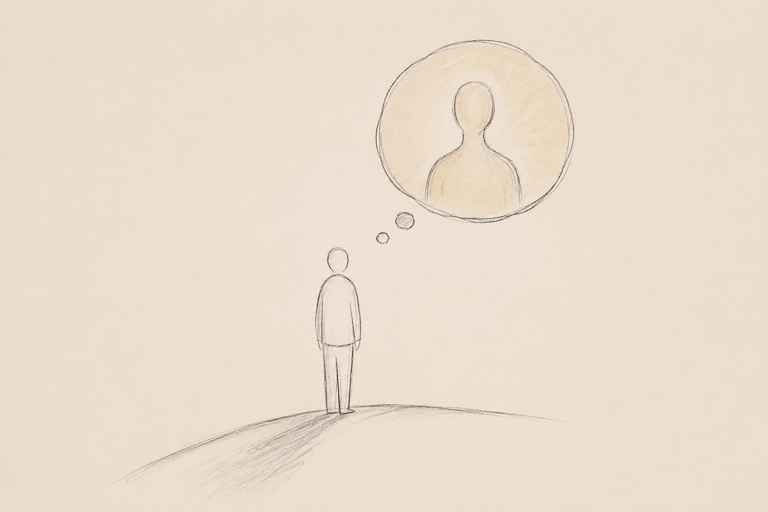
Imagine carrying around a picture of the person you believe you should be, and then forgetting that you’re carrying it.
The picture fades into the background, but it never really leaves. Part of you keeps measuring your life against it without even realising it.
You find yourself striving, apologising, improving, comparing or feeling disappointed, but you can’t quite explain why.
This is one way of understanding what the Enneagram calls the idealised image.
It is the picture we carry of the person we believe we need to be. Not necessarily consciously. It’s not like we sat down and decided, “This is who I need to become.”
It develops gradually. Through family, school, relationships, culture, religion, peers and our own experiences, we begin to discover which qualities seem to bring belonging, approval, safety or love.
Over time, the picture becomes familiar. Eventually, we can forget that it is a picture at all.
We simply experience it as me.
Why does this matter?
Because these ideas can be organising our lives without us knowing.
The clearer we become about what is driving us, the freer we are from the confines of personality.
One of my Enneagram teachers used to describe personality as a kind of prison, except we don’t know we’re behind bars. The patterns are so familiar that we can mistake them for who we are.
Jung suggested that we don’t usually solve life’s deepest problems; we outgrow them. But we can’t outgrow something we mistake for who we are.
In Zen they speak about taking the backward step. Stepping back just enough that we can begin noticing personality rather than living entirely inside it. From here, a different kind of seeing becomes possible.
If we’re interested in life’s deeper questions, what ultimately matters, what makes a life meaningful, what this unique life is here to express, then sooner or later we have to begin teasing apart what belongs to personality from what belongs to something deeper.
James Hollis makes such an important point here. Meaning doesn’t necessarily make us suffer less. But we can endure far more suffering when our lives are rooted in meaning.
We are meaning-making beings. To loose meaning is one of the deepest forms of suffering.
And this creates an interesting dilemma. As we begin moving towards what genuinely matters, towards the life inside us that wants expression, so too do our loudest critics begin speaking.
“Who do you think you are?”
“Not yet.”
“You’ll embarrass yourself.”
“Maybe when you’re better.”
“Don’t risk it.”
One thing I’ve really noticed over the past few weeks working with the critic in groups is that as we begin moving towards what really matters, these critics often get louder.
It makes sense. They’re trying to pull us back from the possibility of failure, embarrassment, shame or humiliation and towards what has always felt safer.
But what else are they protecting?
Very often, they are protecting an idealised image of who we believe we need to be.
The critics hold us accountable to that image.
“Be more like this.”
“Don’t be that.”
“If you fail to live up to this, you won’t belong.”
Somewhere in childhood we each reached conclusions about who we needed to be in order to maintain connection, safety or belonging. We stopped remembering them as adaptations and started experiencing them simply as who I am.
There is nothing inherently wrong with socialisation. We all need it. But these strategies can become frozen in time. They continue organising our lives long after the conditions that created them have passed.
This is why James Hollis, Richard Rohr and others describe the second half of life as a different task altogether. In the simplest way, a return to curiosity.
Asking:
What is seeking expression through me?
What ultimately matters? What is the alive thread running through my life, and what happens if I follow it?
Very often, the answer asks us to risk disappointing the idealised image we’ve spent a lifetime protecting.
The nine idealised images
The Enneagram describes nine common ways this idealised picture can take shape.
We’ll recognise pieces of ourselves in all nine, but usually one becomes particularly powerful—a lens through which we organise our lives.
1 — I am good.
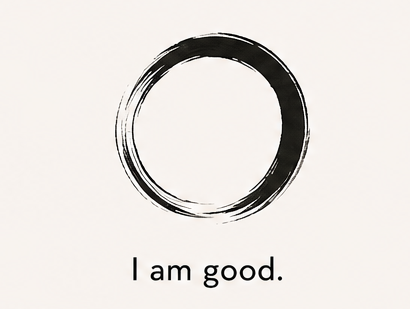
The picture is of someone who is good, responsible, disciplined and morally right.
There is a strong sense of how things should be and how I should behave.
Mistakes can feel bigger than mistakes. They can become evidence that I am failing to be the person I am supposed to be.
The image says:
“If I can get it right, behave properly and do the right thing, I can be a good person.”
2 — I am helpful.
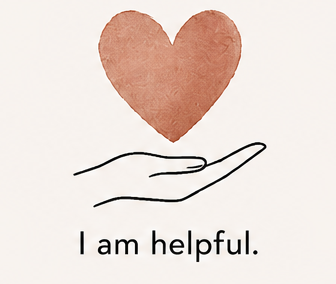
The picture is of someone who is loving, generous, caring and needed.
Being there for other people becomes central to identity.
I know what others need. I anticipate it. I give. I support. I become indispensable.
The image says:
“If I am loving enough and useful enough to other people, I will be loved.”
Over time, knowing what I need can become much harder.
3 — I am successful.
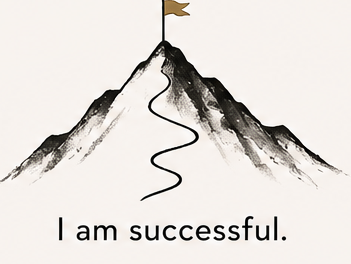
The picture is of someone who is successful, capable, impressive and valued.
I learn to notice what counts as success and become very good at moving towards it.
Achievement, competence and recognition can become measures of worth.
The image says:
“If I can become successful enough, I will know that I am enough.”
The danger is that I can become very good at achieving what matters to everyone else while losing contact with what matters to me.
4 — I am special.
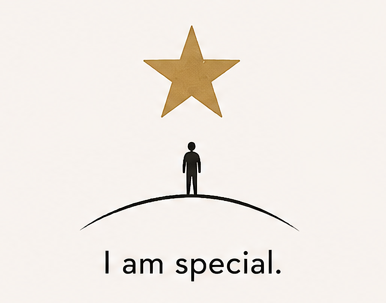
The picture is of someone who is deeply authentic, unique, significant and fully themselves.
There is a longing to discover the real me, the person beneath the ordinary surface.
Being ordinary can feel like disappearing.
The image says:
“There is something uniquely me that needs to be discovered and expressed.”
And so comparison can become painful: Why does everyone else seem to have what I am missing?
5 — I am wise.
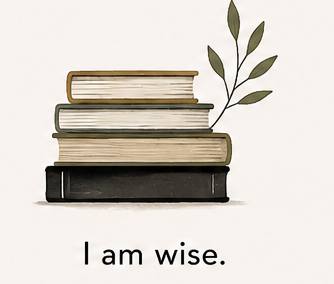
The picture is of someone who is knowledgeable, capable, self-sufficient and able to understand how things work.
Understanding becomes a form of safety.
If I know enough, prepare enough and understand enough, perhaps I won’t be overwhelmed by life.
The image says:
“If I can understand the world, I can find my place in it.”
The mind becomes a place to retreat to when the demands of life feel too much.
6 — I am responsible.
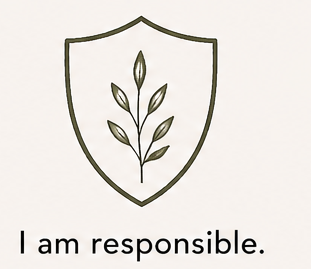
The picture is of someone who is loyal, prepared, dependable and responsible.
I anticipate problems. I think things through. I try to make sure people are safe and that nothing important is overlooked.
The image says:
“If I am responsible enough, prepared enough and loyal enough, I can prevent things from going wrong.”
There can be a deep belief that it is my job to notice what others might miss.
7 — I am happy.
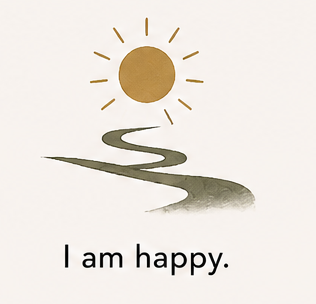
The picture is of someone who is positive, optimistic, adventurous, free and full of possibilities.
Life should remain open.
There should always be another option, another experience, another possibility.
The image says:
“If I can keep life interesting and positive, I won’t get trapped in pain or limitation.”
Pain can then become something to move through quickly rather than something to stay with.
8 — I am strong.
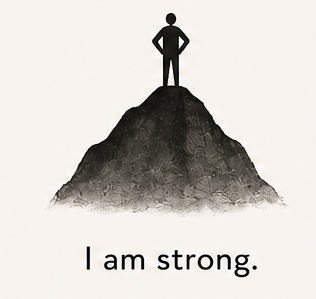
The picture is of someone who is strong, independent, powerful and able to handle whatever life brings.
Vulnerability can feel dangerous.
Dependence can feel risky because it creates the possibility of being controlled, betrayed or hurt.
The image says:
“If I am strong enough, no one can overpower me.”
So I learn to trust my strength and may find it harder to recognise my tenderness.
9 — I am peaceful.
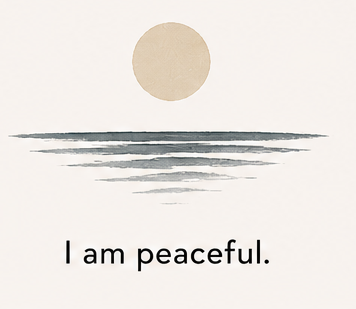
The picture is of someone who is easy-going, accepting, harmonious and able to get along with everyone.
Conflict feels threatening because it risks separation and disconnection.
The image says:
“If I can keep things peaceful and stay connected to everyone, everything will be okay.”
My own priorities can gradually become harder to hear when maintaining harmony becomes more important than taking up space.
We’ll recognise pieces of ourselves in all of these, but usually one becomes the lens through which we organise our lives.
Ironically, the strongest clue that you’ve found yours is that you probably won’t like it.
There’s often something in us that doesn’t want to be seen holding that image.
But the image itself isn’t the problem. It developed in a context. It made sense.
If we can understand the conditions in which it was born, we can respond with curiosity.
“Oh yes… of course.”
Instead of:
“Oh no… what’s wrong with me?”
Even though the adaptation was protective, it still shapes how we relate to ourselves and others today.
These images shape our relationships, careers, parenting, spirituality and our sense of self.
When our identity becomes tied to them, they can begin separating us from the gloriously imperfect, contradictory human being we actually are.
Our identification is the problem, not the ideal.
In fact, every one of these images contains something beautiful.
Goodness.
Love.
Competence.
Authenticity.
Wisdom.
Responsibility.
Joy.
Strength.
Peace.
These are all deeply human qualities.
The difficulty begins when personality mistakes one of them for the way we have to be.
When a part of us believes:
“Only if I become this person will I finally be enough.”
Instead of looking for a type on the Enneagram, we might ask something slightly different:
What image have I spent my life trying to become?
What is the person I carry around in my mind—the person I believe I should be?
And if I no longer had to live up to that image…
Who might I become instead?
A final reflection
If this resonates, you might become curious about the voices that keep comparing you to this idealised image.
I’ve recently developed an Inner Critic Assessment that offers a breakdown of your dominant critic characters and how they tend to organise around these images.
If you’d like to explore them, you can complete the assessment below and I’ll send you an individual report.
For parts and paper journalling groups, you’re welcome to join the mail list for updates.