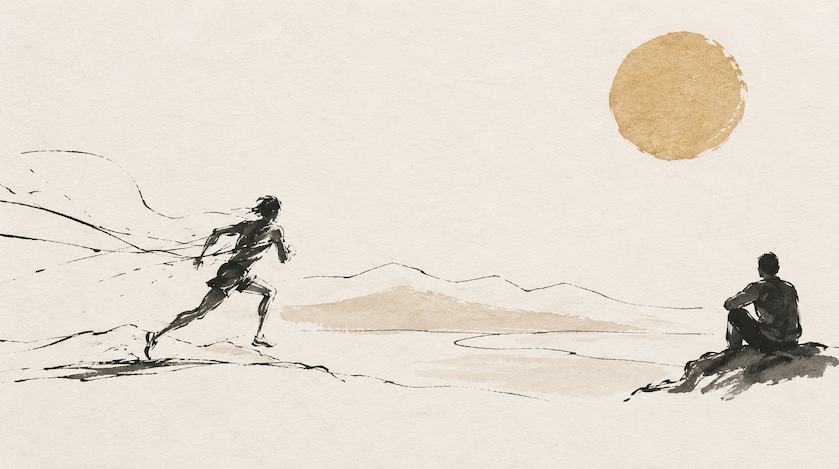
My brother and I have often called my mother out on running. She is the kind of person who doesn’t stay still for very long. She has always been a mother with many balls in the air at once.
Her brother, on the other hand, is very different. You might think this is the better way. Why wasn’t she more like him?
One marriage. A lot of stability. The same home for the few decades that spanned his five children. Church, security and all the common sense in the world. Who wouldn’t want that?
I was sitting with my mother recently and it dawned on us that we are both runners.
“Me too,” I told her. “I’m a runner.”
I know exactly what you mean. You just couldn’t stay still. It wasn’t easy to settle.
And my brother, just like my uncle, is not like that. My brother has always been stable in that way. He didn’t need to go very far from home. He was always more interested in the creature comforts of staying right where he was.
Me, on the other hand, left for overseas almost the minute I finished school. I wanted to get far away from my life. Overseas seemed like far enough.
And surely, as I know now and didn’t know then, another place could not really have the answers, because I took myself with me everywhere I went.
But the runner in me took a long time to learn that lesson. It kept telling the story of movement.
Let’s move. We can’t stay here too long. There must be something better over the horizon.
And again, usually there wasn’t. Or there might have been for a short time, but before long that restless, unsettled energy would come back again.
One way to conceptualise what my brother and I are holding, which is not unlike what my mother and her brother were holding, is the polarity of exploration on one end and ground on the other.
You could find different words for it, but these are as close as mine come.
Now, if you say neither side is right or wrong, you can look at my uncle and see all the good that came from his stability, and also see the price he may have paid for that security.
My mother had a million mind-opening experiences that probably would have blown my uncle’s mind. But he was too much on the side of ground to be open to them.
And then we come to my mother, and it isn’t hard to see what more stability and ground might have brought to her life. One garden to attend to. The presence of mind to fully inhabit just one place.
Both are huge. But inevitably, between the two of them, this dynamic gets tossed around like a chew toy, all the while missing the mark.
Both developed in relation to the same pattern, running.
Which begs the question: Where did it come from?
Why did one follow the pattern and the other buckle down?
It turns out one possibility is only a few generations behind.
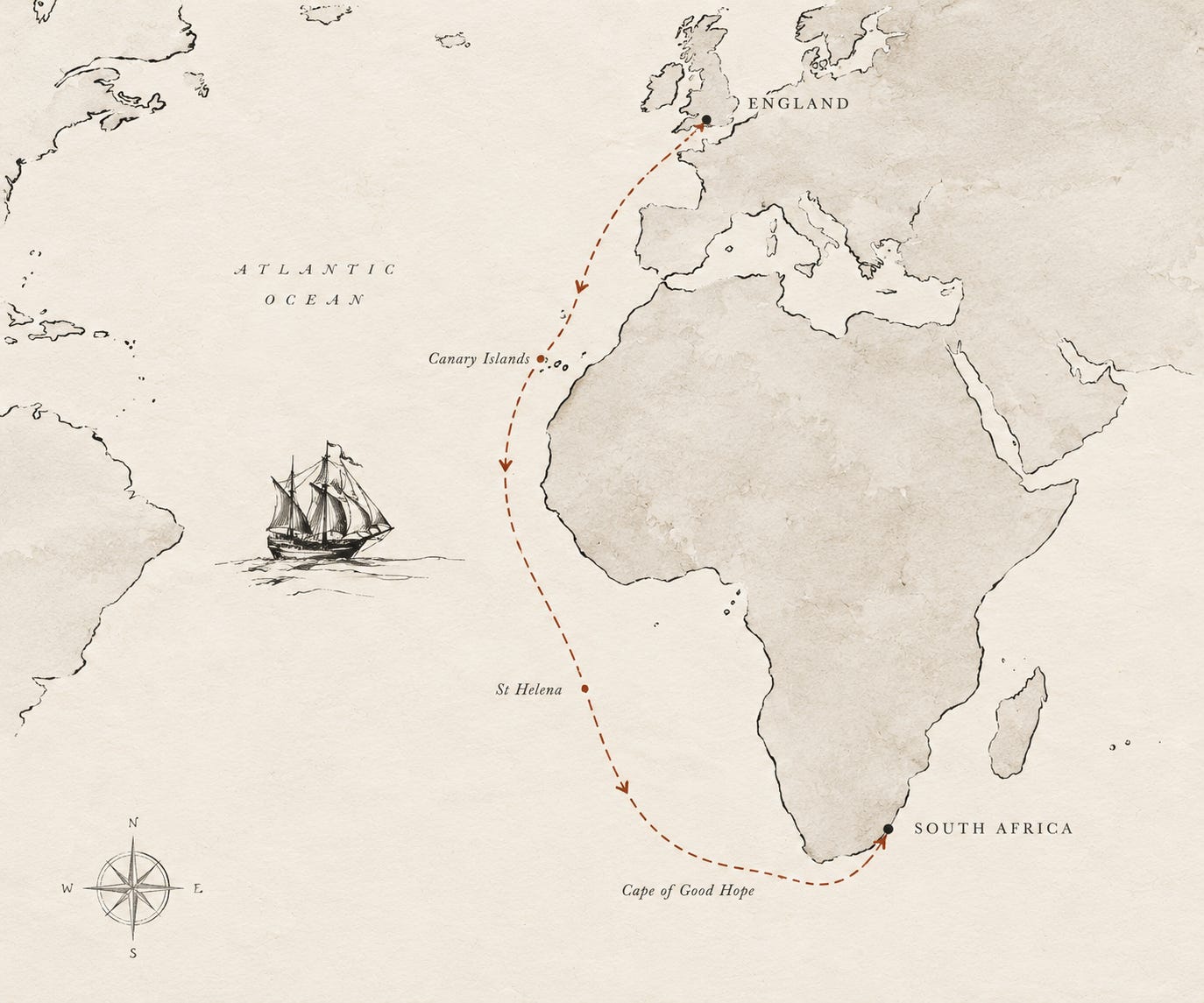
My mother’s great-grandfather left England at a hurried pace. At only eighteen, in the early 1900s, he got on a boat to come to South Africa, knowing only one other person: his cousin who was already here.
I guess you can imagine that for an eighteen-year-old this would have been an adventure of a lifetime. But what must have been happening inside him to make leaving feel possible?
We don’t really know. There is a family story that there may have been a feud between him and his father. There may have been adventure, economics, or who knows what else motivating him.
What we do know is that it was an extreme decision.
He got on a sailing vessel and made the two-week journey to South African soil.
And he did it.
It explains why I call myself South African instead of English.
The moment he got here, the “s” was dropped from the end of the surname and the Oldacre line began.
Not entirely different from the English descendants, minus an “s” at the end of the name, but perhaps more importantly, minus a connection with his relatives.
He took this running with him. Just like I took mine with me the moment I left school.
Even as I’m writing these words I get the shivers. Our experiences were so different, but also, almost a century later, almost identical. We were both runners.
The difference is that he may have had a clearer idea of why he was running, whereas for my mother and I, and all the others in the family who picked up the running, well, I speak for myself: I had my own reasons, but it was also something bigger than just me.
It was just what was inside me. The loudest voice. What felt like the strongest truth. And what you don’t know, you follow.
What is perhaps more interesting is that you may think the running belongs to those on the run. But it’s not like my brother and uncle aren’t running.
I think they are too. Just not in the obvious ways that my mother and I are. They show how you can be in the same place and still run from yourself by focusing on other things. My uncle, as amazing a person as I see him to be, I think escaped through material things and success.
He doubled down on his belonging by being the most charming person he knew. And you would have had to be crazy not to be seduced by his likability.
That was his way of dealing with this complex theme of belonging that his ancestor had left him, and all of us, with. The massive move of country and home.
Who are we now?
Where do we belong?
The running is in us now. It is our comfort when life moves us too close to that theme.
And naturally, the antidote to all of this is to bring the story out into the open, where it can be seen and understood.
We can ask: Who are the people in the family and wider family system who react to this movement?
A man leaving home, never to return.
Who are the runners? Who are the stayers? And what did it cost them?
What if there were a way they could each give something to the other from their side?
The runner gives exploration.
A bigger view. Possibility. The willingness to leave what is familiar.
And perhaps the stayer gives ground. Continuity. Place. The ability to remain long enough to really inhabit somewhere.
To me, more than anything, this shows the power of story.
Just imagine if my mother and uncle had grown up hearing a more resolved form of the story.
Maybe their parents told them the story of their great-grandfather and how, essentially, he had his reasons for running.
But we don’t need to anymore.
We are safe now.
We have a sense of place and space and who we are.
We can keep growing this belonging story with each generation.
And we can send many gratitudes to our ancestor for bringing us to this new land that opened our minds and souls.
It seems like a better story to tell.
But more importantly, the story itself is in the light. And as long as there is a generation that carries it, it seems unlikely that we will forget.
If anything, it starts to become a story of strength and resilience. And perhaps this is what family stories can give us.
Maybe the work isn’t to stop the running, or to try to make ourselves stay. Instead, it is to know the story well enough that our movements of staying or going can come in response to present realities.
And stories can be the way in. A good story can give us the right amount of distance to do it differently.